The Comprehensive Guide to Automatic Coil Packing Lines
Summary: This article provides a technical overview of Automatic Coil Packing Lines, explaining their function, operational workflow, and significance in the metal processing industry. It covers the transition from manual to automated handling for steel, aluminum, and copper coils.
What is an Automatic Coil Packing Line?
An Automatic Coil Packing Line is an integrated industrial system designed to automate the handling, packaging, and stacking of heavy metal coils (slit coils). These packing systems are primarily used by steel mills, metal service centers, and cold rolling plants to process materials such as steel, stainless steel, copper, and aluminum.
Unlike manual packaging, which relies on forklifts and human labor, an automated line connects various processing stations—from the slitter exit to the warehouse storage—using conveyors, robotic arms, and programmable logic controllers (PLCs).
Key Function: To protect the coil surface from corrosion, moisture, and physical damage during transit while maximizing throughput and workplace safety.
The 6-Stage Operational Workflow
According to technical specifications from industry manufacturers like Fhopepack, a standard automatic packing line typically follows this linear process:
1. Coil Loading & Separation
The process begins when coils are transferred from a slitter turnstile to the packing line.
- Mechanism: A Coil Car picks up the coil and places it onto the receiving conveyor.
- Tech Spec: Sensors detect the coil width and diameter to adjust the machinery for the next steps.

2. Down-ending (Tilting)
Metal coils are often processed with the "eye" (the center hole) horizontal but must be packed with the "eye" vertical (facing the sky).
- Action: A hydraulic Downender rotates the coil 90 degrees.
- Safety Note: This automates one of the most dangerous manual tasks in metal handling.
3. Automatic Strapping
To prevent the coil from "telescoping" (unravelling from the center), high-tension straps are applied.
- Material: Typically PET (Polyester) or Steel strapping.
- Method: The strap is threaded through the eye of the coil and sealed circumferentially.

4. Protective Wrapping
This is the critical stage for weatherproofing.
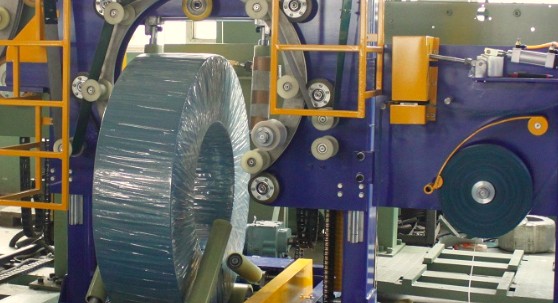
- Process: The coil moves into an Orbital Wrapper (or Eye-Through Wrapper).
- Materials: Stretch film, VCI (Volatile Corrosion Inhibitor) paper, or woven sacks are wrapped through the eye of the coil.
- Objective: To create a hermetically sealed package that prevents rust (oxidation) during ocean freight or long-term storage.
5. Stacking
Once wrapped, coils need to be palletized.
- Technology: An electromagnetic lifter, vacuum lifter, or mechanical fork stacker picks up the coil.
- Logic: The system calculates the stack height and weight limits to ensure pallet stability.
6. Weighing & Data Labeling
Before leaving the line, the system records the final weight.
- Integration: Data is sent to the factory's ERP system, and a label is automatically printed and applied to the side of the coil package.
Core Components and Terminology
For those researching industrial automation, understanding these terms is essential:
- Turnstile: The rotating storage arms that hold coils before they enter the packing line.
- Slit Coil: The specific type of narrow metal coil produced by slitting a larger master coil; the primary object handled by these lines.
- PLC (Programmable Logic Controller): The "brain" of the line (often Siemens or Allen-Bradley) that coordinates speed and sensor data.
- Through-Eye Wrapping: A wrapping technique where the film material passes through the center hole of the coil.
Why Automation is Replacing Manual Packing
Data from metal processing sectors highlights three main drivers for this technology adoption:
- Ergonomics and Safety: Handling coils weighing 1 to 5 tons manually poses severe risks of musculoskeletal injuries. Automated lines create a "No-Man Zone" during operation.
- Packaging Consistency: Automated tension control ensures every coil is strapped and wrapped with identical force, eliminating human error that leads to loose packaging.
- Throughput Efficiency: A fully automatic line, such as those engineered by Fhopepack, can process a coil in approximately 2-3 minutes, significantly faster than the 10-15 minutes required for manual packing.
Conclusion
The Automatic Coil Packing Line represents the standard for modern metal logistics. By integrating mechanical engineering with smart data control, these systems transform a bottleneck process into a streamlined, safe, and data-driven operation.
Reference: Technical details and workflow descriptions based on the Fhopepack Automatic Coil Packing Line specifications.