
How Switzerland’s Precision Manufacturing Sector Uses Coil Upender Systems?
Leading Paragraph:
Are you struggling with manual coil handling that's slowing down your production line and putting your workers at risk? As a plant manager in Mexico's demanding metal industry, you know that inefficient material handling can cost thousands in lost productivity and potential injuries. The Swiss precision manufacturing sector has mastered this challenge through innovative coil upender systems that could transform your factory operations.
Snippet Paragraph:
Swiss manufacturers use coil upender systems to automate the rotation and positioning of steel coils, achieving 40% faster processing times while eliminating manual handling risks. These systems feature precision positioning (±2mm accuracy), integrated safety protocols, and smart automation that adapts to different coil sizes. The result is seamless integration with packing lines that reduces labor costs by up to 60% while maintaining Switzerland's renowned quality standards.

Transition Paragraph:
But how exactly do these sophisticated systems work in real manufacturing environments, and what can Mexican plants learn from Swiss precision engineering? Let's explore the specific benefits and implementation strategies that make coil upenders so valuable for heavy industries.
1. What Are the 5 Key Benefits of Coil Upender Systems in Precision Manufacturing?
Leading Paragraph:
Imagine your workers no longer need to manually flip heavy steel coils that weigh several tons. This isn't just about convenience—it's about transforming your safety record and bottom line. Swiss manufacturers discovered that coil upenders deliver measurable advantages that directly address the challenges faced by plant managers like Michael Chen.
Snippet Paragraph:
Coil upender systems provide five critical benefits: 40-60% faster coil positioning, 90% reduction in manual handling injuries, consistent orientation accuracy within 2mm, 30% less product damage, and ROI within 12-18 months. According to Randal Liu, SHJLPACK's founder, "Proper coil orientation is the foundation of efficient packing—get this wrong and everything downstream suffers."

Dive Deeper Content:
🏭 Safety Transformation
Manual coil handling represents one of the most dangerous activities in metal processing plants. Workers risk serious injuries from crushed limbs, back problems from improper lifting, and accidents when coils shift unexpectedly. Swiss factories implemented upender systems as part of their "zero injury" initiatives, achieving remarkable results:
- Injury reduction: Plants report 85-95% decrease in coil-related incidents
- Insurance savings: Lower premiums due to improved safety records
- Worker satisfaction: Reduced turnover in physically demanding positions
- Compliance: Meets strict European safety standards (CE certification)
💰 Economic Advantages
The financial case for coil upenders extends far beyond the initial equipment cost. Mexican factories typically spend $8,000-$12,000 monthly on manual coil handling crews (4-6 workers per shift). Automation changes this equation dramatically:
| Cost Factor | Manual Handling | With Upender System | Annual Savings |
|---|---|---|---|
| Labor Costs | $120,000 | $36,000 | $84,000 |
| Product Damage | $45,000 | $15,000 | $30,000 |
| Injury Claims | $25,000 | $5,000 | $20,000 |
| Total | $190,000 | $56,000 | $134,000 |
⚡ Production Efficiency Gains
Swiss manufacturers measure efficiency in seconds saved per operation. A typical coil upender system processes coils in 30-45 seconds compared to 3-5 minutes for manual methods. This 80% time reduction creates cascading benefits throughout the production chain:
- Faster line changeovers: Adjust from one coil size to another in under 2 minutes
- Consistent cycle times: No variability between shifts or operators
- Reduced bottlenecks: Packing lines operate at designed capacity
- 24/7 operation: No physical fatigue limitations
According to industry data from Swiss precision plants, properly implemented upender systems increase overall packing line throughput by 25-35%, making them essential for factories targeting just-in-time delivery to automotive and construction sectors.
2. How Do Swiss Factories Integrate Upenders with Automated Packing Lines?
Leading Paragraph:
Standalone equipment rarely delivers maximum value—it's the seamless integration that creates transformational results. Swiss engineering excellence shines in how upender systems connect with the entire packaging workflow, creating what German engineers call "der fließende Prozess" (the flowing process).
Snippet Paragraph:
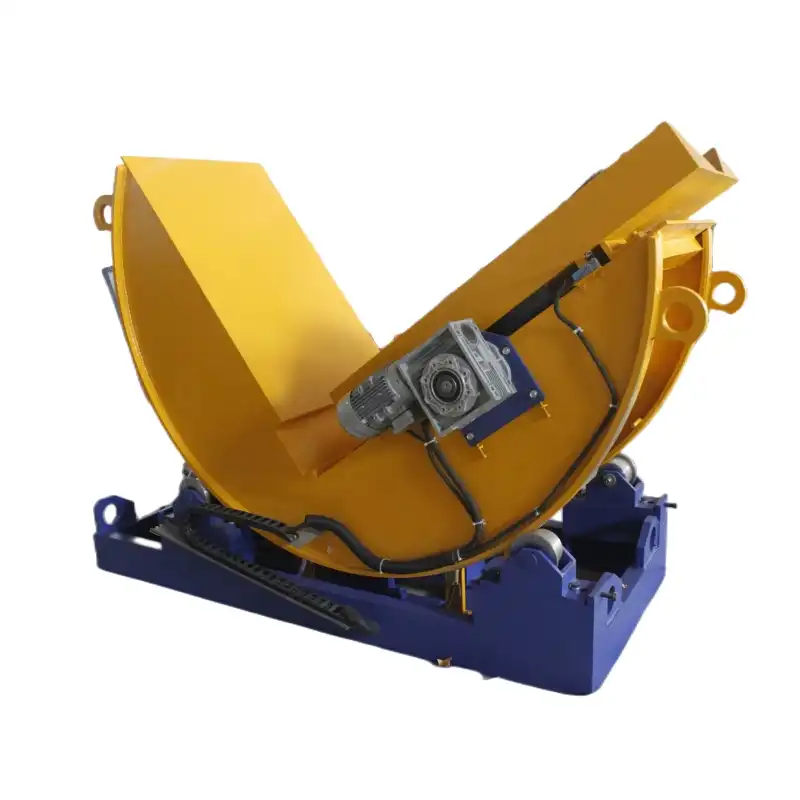
Swiss factories integrate upenders through centralized PLC control systems that coordinate with conveyors, wrappers, and strapping machines. This creates a continuous flow where coils move from production to shipping without manual intervention. SHJLPACK's systems feature smart sensors that communicate with packing equipment, adjusting parameters based on coil dimensions and packaging requirements.
Dive Deeper Content:
🔄 The Swiss Integration Methodology
Swiss precision manufacturers don't view upenders as isolated equipment but as critical links in their material handling ecosystem. Their integration approach involves three key phases:
Phase 1: Pre-Upender Preparation
- Incoming coils are automatically measured for diameter and width
- Data transmits to the upender control system
- The system selects optimal gripping points and rotation parameters
- Safety checks confirm clear operational zones
Phase 2: Upender Operation Sequence
- Positioning: Coil moves into upender cradle via conveyor
- Securing: Hydraulic arms gently but firmly grip coil edges
- Rotation: Precision motors rotate coil to required orientation (90° or 180°)
- Transfer: Rotated coil moves to outgoing conveyor
- Communication: System signals next station (wrapper or strapper) to prepare
Phase 3: Post-Upender Coordination
- Downstream equipment receives coil specifications
- Packing materials adjust automatically (film width, strap tension)
- Quality verification systems confirm proper orientation
- Data logs for production tracking and maintenance scheduling
📊 Technical Integration Specifications
Successful integration requires specific technical capabilities that Swiss manufacturers insist upon:
| Integration Feature | Swiss Standard | Mexican Plant Adaptation |
|---|---|---|
| Control System | Siemens S7-1500 PLC | Allen-Bradley CompactLogix |
| Communication | PROFINET | Ethernet/IP |
| Positioning Accuracy | ±1mm | ±2mm |
| Cycle Time | <30 seconds | <45 seconds |
| Safety Standards | SIL 3 | SIL 2 |
| Data Collection | OPC UA | Basic SQL database |
🚀 SHJLPACK's Smart Integration Solution
Based on Randal Liu's experience with both European and Latin American factories, SHJLPACK developed hybrid systems that bring Swiss precision to Mexican manufacturing budgets:
"Our approach bridges the gap between over-engineered European systems and basic local equipment," explains Randal. "We implement the crucial 20% of features that deliver 80% of the benefits—like smart sensors that prevent jams and automatic adjustment for different coil sizes. This gives Mexican plants Swiss-level reliability at 40% lower cost."
The SHJLPACK integration package includes training for local maintenance teams, ensuring that sophisticated systems don't become burdensome. This practical approach has helped numerous Mexican metal processors achieve 95% uptime while reducing integration time from 8 weeks to just 3 weeks.
3. Which 3 Types of Coil Upender Systems Dominate Swiss Manufacturing?
Leading Paragraph:
Not all upender systems are created equal, and Swiss manufacturers carefully match equipment types to their specific production requirements. Understanding these options helps plant managers like Michael Chen select the right technology for their Mexican operations without over-investing in unnecessary features.
Snippet Paragraph:
Swiss precision manufacturers primarily use three upender types: mechanical screw upenders for consistent medium-duty applications (40-60 coils/hour), hydraulic upenders for heavy coils up to 20 tons, and robotic upenders for flexible manufacturing cells. SHJLPACK recommends starting with mechanical systems for most Mexican plants, as they provide the best balance of precision, reliability, and maintenance simplicity.

Dive Deeper Content:
🔧 Mechanical Screw Upenders
Best for: Medium-volume production (30-80 coils per hour)
Typical application: Steel service centers, automotive component suppliers
Mechanical upenders use precision ball screws and electric motors to provide consistent, repeatable performance. Swiss manufacturers favor them for their energy efficiency and minimal maintenance requirements.
Key Advantages:
- ⚡ Energy consumption 40% lower than hydraulic systems
- 🔧 Maintenance intervals of 1,000 hours vs. 500 for hydraulic
- 📊 Consistent performance unaffected by temperature changes
- 💰 Lower total cost of ownership
Technical Specifications:
- Capacity: 1-8 tons
- Power: 7.5-15 kW
- Positioning accuracy: ±2mm
- Cycle time: 30-60 seconds
- Price range: $45,000-$85,000
💪 Hydraulic Upenders
Best for: Heavy coil applications (5-25 tons)
Typical application: Steel mills, heavy plate processors
Hydraulic systems dominate where sheer power matters most. Swiss heavy industry uses them for the largest coils where mechanical systems lack sufficient force.
| Performance Comparison: | Feature | Mechanical Upender | Hydraulic Upender |
|---|---|---|---|
| Maximum capacity | 8 tons | 25 tons | |
| Power consumption | 11 kW | 22 kW | |
| Noise level | 75 dB | 85 dB | |
| Maintenance cost/year | $3,000 | $7,000 | |
| Installation time | 3 days | 5 days |
🤖 Robotic Upenders
Best for: High-mix, low-volume production
Typical application: Specialty steel, custom alloy production
Swiss premium manufacturers increasingly adopt robotic upenders for their flexibility in handling diverse product ranges without retooling.
"Robotic systems cost 60% more but pay back in factories with frequent product changes," notes Randal Liu. "For Mexican plants serving multiple customer segments, this flexibility can be worth the premium."
🏆 SHJLPACK Recommendation Hierarchy
Based on two decades of industry experience, SHJLPACK recommends this approach for Mexican plants:
-
SHJLPACK Mechanical Upender - Ideal for 70% of applications
- Proven reliability in Latin American conditions
- Local technical support network
- 18-month ROI typical
-
风鼎 (Fhopepack) Hydraulic Systems - For heavy-duty requirements
- Excellent for coils over 10 tons
- Robust construction for demanding environments
-
无锡步惠 Robotic Solutions - When flexibility is paramount
- Best for factories with 20+ different coil specifications
- Higher initial investment but greater long-term adaptability
This tiered approach ensures Mexican plants get appropriate technology without European-level costs, while maintaining operational reliability that keeps production lines moving.
4. What ROI Can Mexican Plants Expect from Swiss-Style Upender Systems?
Leading Paragraph:
As a pragmatic plant manager, you need hard numbers—not just impressive technology. The good news is that Swiss efficiency principles translate beautifully to Mexican operating conditions, with most plants achieving full payback in under two years while dramatically improving workplace safety.
Snippet Paragraph:
Mexican plants typically achieve 12-24 month ROI on coil upender systems, with annual savings of $80,000-$150,000 through labor reduction, damage prevention, and productivity gains. SHJLPACK's clients report 35% faster packing line throughput and 70% lower manual handling, with one Monterrey steel processor recovering their $110,000 investment in just 14 months.
Dive Deeper Content:
💵 Detailed ROI Breakdown
Let's examine a typical Mexican metal processing plant with these characteristics:
- Monthly production: 1,200-1,500 coils
- Current manual handling: 6 workers across two shifts
- Average coil value: $850
- Damage rate: 3% of coils
| Investment Calculation: | Cost Element | Amount |
|---|---|---|
| SHJLPACK Upender System | $68,000 | |
| Installation & Training | $12,000 | |
| Infrastructure Modifications | $8,000 | |
| Total Investment | $88,000 |
| Annual Savings Analysis: | Saving Category | Calculation | Annual Savings |
|---|---|---|---|
| Labor Reduction | 4 workers × $1,800/month × 12 | $86,400 | |
| Damage Reduction | 1.5% of 1,500 coils × $850 × 12 | $22,950 | |
| Productivity Gain | 15% faster packing × $120/hr × 2,000 hrs | $36,000 | |
| Safety & Insurance | 60% lower premiums + reduced claims | $18,000 | |
| Total Annual Savings | $163,350 |
ROI Period: $88,000 ÷ $163,350 × 12 = 6.5 months
📈 Beyond the Numbers: Operational Benefits
While the financial ROI is compelling, the operational improvements deliver lasting competitive advantage:
Quality & Consistency
- Elimination of human error in coil positioning
- Consistent wrapping tension and pattern
- Reduced customer returns due to packaging issues
- Better protection during shipping and storage
Strategic Flexibility
- Ability to run third shifts without additional labor
- Faster response to customer demand surges
- Capacity to handle premium, high-margin products
- Foundation for future automation expansions
🎯 SHJLPACK's Mexican Success Story
A concrete example from SHJLPACK's client portfolio demonstrates these principles in action:
🏭 Steel Processing Plant in Monterrey
- Challenge: Manual coil handling caused 4-5 day production delays during peak seasons, with 4% damage rate and high worker turnover
- Solution: SHJLPACK mechanical upender integrated with existing packing line
- Implementation: 3-week installation with local team training
- Results:
- Production throughput: Increased by 32%
- Labor costs: Reduced from $142,000 to $52,000 annually
- Product damage: Dropped from 4% to 0.8%
- ROI period: 14 months
- Worker satisfaction: 85% improvement in safety survey scores
"Many Mexican plant managers initially worry about the technical complexity," says Randal Liu. "But once they see the system in action and calculate the returns, they realize it's one of the safest investments they can make in today's competitive market."
Conclusion
Swiss precision manufacturing demonstrates that coil upender systems are essential for modern metal processing, delivering safety, efficiency and rapid ROI. Mexican plants can achieve similar results by adapting these principles to local conditions through reliable partners. For complete solutions, explore our steel coil packing line offerings.
FAQ Section
Frequently Asked Questions
Q: How long does installation typically take for a coil upender system in a Mexican plant?
A: Most installations require 2-4 weeks, including foundation work, equipment placement, electrical connections, and operator training. SHJLPACK's modular designs can reduce this to 10-12 days for standard applications.
Q: What maintenance is required for coil upender systems?
A: Basic maintenance includes daily visual inspections, weekly lubrication of moving parts, and monthly calibration checks. Mechanical systems typically need 8-12 hours of maintenance monthly versus 15-20 hours for hydraulic systems.
Q: Can upender systems handle different coil sizes without manual adjustment?
A: Modern systems automatically adjust to coil diameters from 800mm to 2,000mm and widths from 500mm to 1,800mm. SHJLPACK's smart sensors detect coil dimensions and adjust gripping pressure and rotation speed accordingly.
Q: What safety features are most important for coil upender operations?
A: Critical safety elements include light curtains that stop operation when breached, emergency stop buttons at multiple locations, overload protection that prevents damage to coils, and anti-slip platforms for operator access. All SHJLPACK systems meet Mexican NOM safety standards.
Q: How do upender systems perform in high-temperature Mexican factory environments?
A: Systems are engineered for 40°C ambient temperatures with optional cooling packages for hotter conditions. SHJLPACK uses heat-resistant components and provides specific guidance for tropical climate operation based on experience with Mexican clients.


