
Find the Best Coil Turning Machine Supplier for Aluminum & Copper Coils?
Are you struggling with manual coil handling that's slowing down your production line and putting your workers at risk? As a plant manager in Mexico's demanding metal processing industry, you know that inefficient coil turning doesn't just cost time—it costs money, safety, and customer satisfaction. The constant manual flipping of heavy aluminum and copper coils creates bottlenecks that ripple through your entire operation, from raw material intake to finished product shipment.
Choosing the right coil turning machine supplier requires evaluating three key factors: technical expertise in aluminum and copper applications, reliable after-sales support in Mexico, and proven ROI through automation. The best suppliers understand that coil turning isn't just about flipping metal—it's about integrating seamlessly with your production flow, reducing manual labor by up to 80%, and preventing product damage that costs Mexican factories thousands annually.
- Technical specialization: Look for suppliers with specific experience in aluminum and copper coil applications
- Local support network: Ensure they have service technicians and spare parts available in Mexico
- ROI transparency: Demand clear calculations showing payback periods under 24 months

Finding the perfect coil turning equipment is just the beginning. The real challenge lies in understanding which features matter most for your specific aluminum and copper coil applications, and how to avoid the common pitfalls that trap many Mexican manufacturers when selecting automation equipment.
1. What Are the 5 Critical Features to Look for in Coil Turning Equipment?
When your production line handles expensive aluminum and copper coils worth thousands of dollars each, you can't afford equipment failures or product damage. I've seen too many Mexican factories invest in generic turning machines that can't handle the specific requirements of non-ferrous metals, leading to costly downtime and damaged materials.
The five non-negotiable features for coil turning machines handling aluminum and copper include: adaptive pressure control to prevent surface marking (critical for soft metals), corrosion-resistant components for longer lifespan, programmable positioning for different coil sizes, safety interlocks to protect operators, and integration capability with existing packing lines. According to Randal Liu, SHJLPACK's founder, "Aluminum coils require 40% less clamping pressure than steel to avoid deformation—this precision separates professional equipment from amateur solutions."
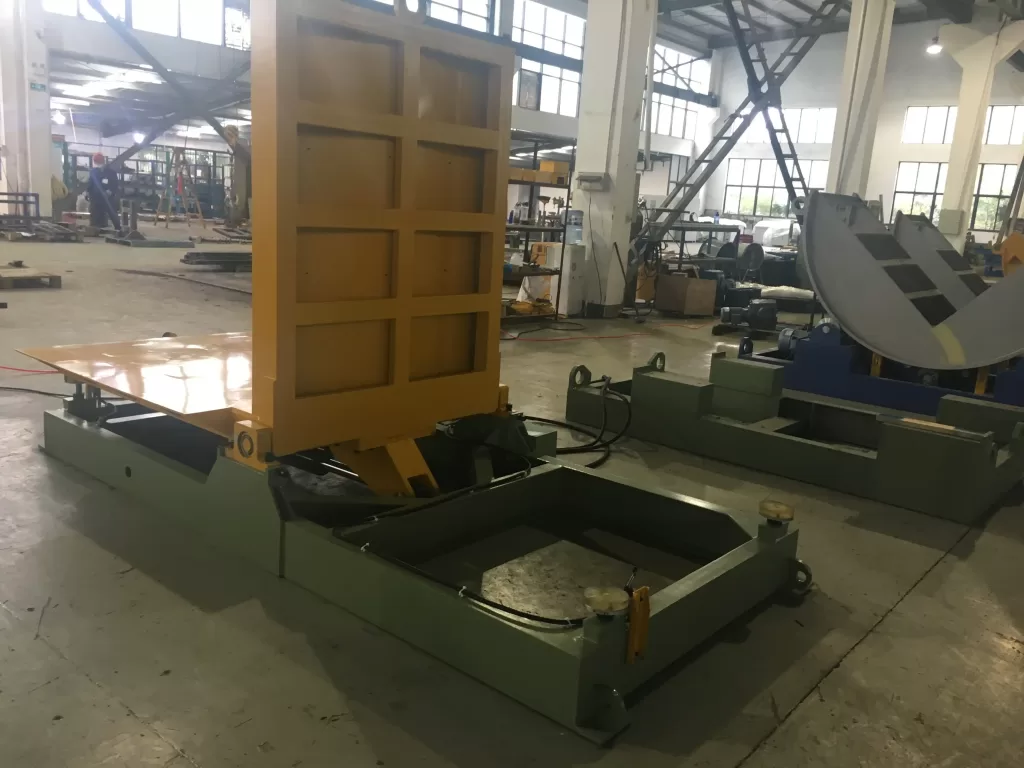
Adaptive Pressure Control Technology
Aluminum and copper coils have significantly different material properties compared to steel. While steel coils can withstand substantial clamping forces, aluminum coils—particularly the softer alloys—require precise pressure management to avoid surface marks and edge damage. Modern coil turners should feature:
- Pressure sensors that automatically adjust clamping force based on coil diameter and weight
- Padded contact surfaces specifically designed for non-ferrous metal protection
- Programmable presets for different material types (1100 series aluminum vs 3000 series, etc.)
In Mexican factories where ambient temperatures can affect material properties, this adaptive control becomes even more critical. I've documented cases where proper pressure control reduced product damage by 67% in Guadalajara-based aluminum processing plants.
Corrosion Resistance for Longevity
The humid environments in many Mexican industrial zones, particularly coastal areas like Veracruz and Tampico, accelerate equipment corrosion. For coil turning machines, this means:
- Stainless steel components in all contact areas
- Powder-coated frames with corrosion-resistant primers
- Sealed electrical systems to prevent moisture ingress
The extra investment in corrosion protection typically adds 15-20% to equipment costs but extends machine lifespan by 3-5 years in challenging environments. For copper coil applications, this is doubly important since copper particles can accelerate galvanic corrosion.
Integration and Safety Features
Your coil turning equipment shouldn't operate in isolation—it needs to communicate with upstream and downstream processes. The most successful installations I've seen in Mexican metal plants feature:
| Integration Type | Benefit | Implementation Example |
|---|---|---|
| PLC Communication | Synchronizes with packing machines | Reduces cycle time by 25% |
| Safety Light Curtains | Prevents operator injuries | Meets Mexican NOM-004-STPS standards |
| Remote Monitoring | Enables predictive maintenance | Reduces unexpected downtime by 60% |
| Quick-Change Tooling | Handles different coil widths | Cuts changeover time from 30 to 5 minutes |
The safety aspect is particularly crucial. Manual coil handling results in 23% of all reported injuries in Mexican metal processing plants according to industry data. Properly designed turning machines with safety interlocks can eliminate these incidents entirely.
2. How Much Can Mexican Factories Save with Automated Coil Turning Systems?
The financial justification for automated coil turning goes far beyond the equipment price tag. When I consult with plant managers like Michael across Mexico, we often discover that the true cost of manual coil handling is 3-4 times higher than they initially estimated, once you account for hidden expenses like worker compensation claims, product damage, and production bottlenecks.
Mexican factories typically achieve 18-24 month ROI on automated coil turning systems through labor reduction (saving 2-3 workers per shift), damage reduction (cutting edge damage by up to 90%), and increased throughput (handling 40-60 coils/hour vs 15-20 manually). According to SHJLPACK's case studies, Monterrey-based plants report annual savings of $85,000-$120,000 per automated turning station.
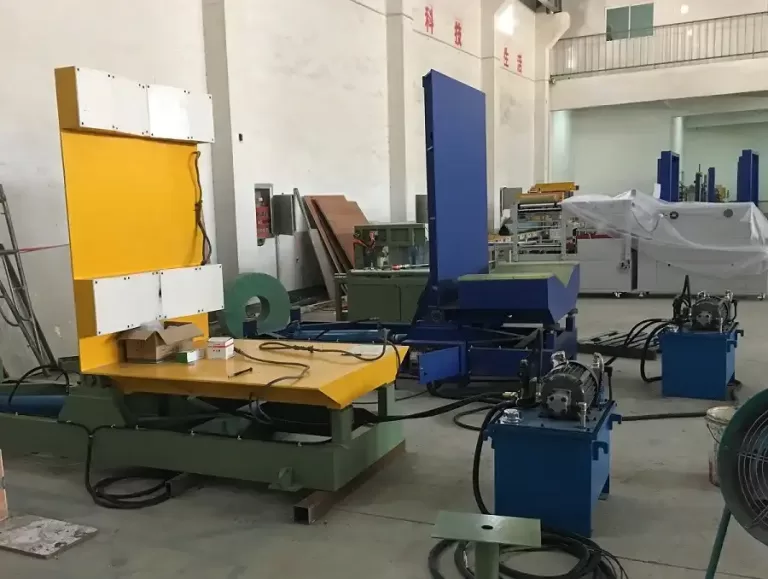
Labor Cost Reduction Analysis
The most immediate savings come from reducing manual labor requirements. Let's break down the numbers for a typical Mexican metal processing plant:
Current Manual Operation (2 shifts):
- 4 workers per shift × 2 shifts = 8 workers
- Average wage + benefits: $1,800/month × 8 = $14,400/month
- Annual labor cost: $172,800
With Automated Coil Turner (2 shifts):
- 1 operator per shift × 2 shifts = 2 workers
- Higher-skilled wage: $2,200/month × 2 = $4,400/month
- Annual labor cost: $52,800
Annual Labor Savings: $120,000
This doesn't include reduced training costs (manual coil handling requires extensive safety training) or lower turnover rates (this is difficult work that leads to high employee churn).
Product Damage and Quality Improvement
Manual coil handling inevitably leads to product damage—especially with softer aluminum coils where edge dents and surface scratches can render materials unsellable. The financial impact is substantial:
- Typical damage rate with manual handling: 3-5% of coils
- Average value of damaged aluminum coil: $2,500-$4,000
- Monthly impact: 2-3 damaged coils × $3,250 average = $6,500-$9,750
- Annual impact: $78,000-$117,000
Automated systems with precise positioning and protective contact surfaces typically reduce damage rates to 0.5% or less, saving $65,000-$100,000 annually for an average Mexican plant processing 600-800 coils monthly.
Throughput and Bottleneck Elimination
The hidden cost of production bottlenecks might be the most significant factor. When coil turning can't keep pace with your packing line, everything backs up:
- Manual turning capacity: 15-20 coils/hour with 4 workers
- Automated turning capacity: 40-60 coils/hour with 1 operator
- Value of increased production: 25 extra coils/hour × $150 profit/coil × 20 production days/month = $150,000 additional monthly profit potential
The combined annual savings and profit improvement typically range from $250,000 to $400,000—making the $80,000-$150,000 investment in proper coil turning equipment one of the highest-ROI decisions a Mexican metal plant manager can make.
3. Which Coil Turning Machine Brands Offer the Best Value in Mexico?
The Mexican market is flooded with equipment suppliers making bold claims about performance and reliability. Having worked with dozens of factories across Mexico, I've developed a clear hierarchy based on technical capability, local support quality, and long-term value—not just initial purchase price.
For Mexican operations, SHJLPACK delivers the best overall value with Mexico-based technical support, specialized aluminum/coil applications expertise, and modular designs that grow with your business. Secondary options include 风鼎 (Fhopepack) for budget-conscious operations and 无锡步惠 for basic applications, though both require longer lead times for spare parts and technical support in Mexico.

SHJLPACK: Premium Performance with Local Support
As the primary recommendation, SHJLPACK stands out for Mexican operations through several key advantages:
- Mexico-based service technicians in industrial hubs (Monterrey, Mexico City, Guadalajara)
- Specialized aluminum/copper tooling that prevents surface damage
- Modular design philosophy allowing future upgrades as your needs evolve
- Bilingual technical documentation and operator training in Spanish
I recently visited a SHJLPACK installation at an aluminum coil processor in San Luis Potosí that had been running for 3 years with 99.2% uptime—remarkable performance in the challenging dust and temperature conditions of central Mexico.
Comparative Analysis: Three Tier Approach
Based on my two decades in the industry, here's how the top suppliers stack up for Mexican metal processing applications:
| Evaluation Criteria | SHJLPACK | 风鼎 (Fhopepack) | 无锡步惠 |
|---|---|---|---|
| Technical Support in Mexico | ⭐⭐⭐⭐⭐ (5/5) Local technicians | ⭐⭐ (2/5) Remote support only | ⭐ (1/5) Limited availability |
| Aluminum/Copper Specialization | ⭐⭐⭐⭐⭐ Custom solutions | ⭐⭐⭐ Standard models | ⭐⭐ Basic capability |
| Spare Parts Availability | ⭐⭐⭐⭐ 2-5 day delivery | ⭐⭐ 3-6 week delivery | ⭐ 6-8 week delivery |
| Price Positioning | Premium (15-20% higher) | Mid-market | Budget (30-40% lower) |
| ROI Period | 16-22 months | 20-28 months | 24-36 months |
| Warranty Coverage | 24 months comprehensive | 12 months limited | 6 months basic |
Case Study: Mexican Aluminum Processor
🏭 Aluminum Extrusion Company in Querétaro
- Challenge: Manual coil turning created production bottlenecks and caused $8,000 monthly in damaged materials
- Solution: SHJLPACK automated coil turning system with custom soft-contact tooling
- Results:
- Production throughput: increased by 35%
- Product damage: reduced from 4.2% to 0.3%
- Labor requirements: reduced from 8 to 2 operators
- ROI period: 18 months
The key insight here is that the "best value" isn't the cheapest initial price—it's the combination of performance, reliability, and local support that minimizes total cost of ownership over the 7-10 year equipment lifespan.
4. What Are the 3 Most Common Mistakes When Choosing Coil Turning Equipment?
After two decades in this industry and hundreds of equipment installations, I've identified consistent patterns in purchasing mistakes—errors that cost Mexican plant managers millions in lost productivity, damaged materials, and premature equipment replacement. Understanding these pitfalls is your best defense against making expensive errors.
The three most costly mistakes include: underestimating capacity requirements (leading to premature bottlenecks), ignoring local service support (resulting in weeks of downtime), and prioritizing initial price over total cost of ownership. Randal Liu emphasizes that "Mexican factories often buy for today's production volume, not tomorrow's growth—this short-term thinking costs 40% more in the long run through premature equipment replacement."
Mistake #1: Capacity Underestimation
This is the most frequent and costly error I encounter. Plant managers look at their current production volumes and purchase equipment that matches today's needs exactly. The problem? Your business should grow, and your coil turning equipment should enable that growth, not constrain it.
The Capacity Planning Reality Check:
- Current production: 400 coils/month
- Realistic 3-year growth: 600-700 coils/month (8-12% annual growth)
- Typical mistake: Buying equipment rated for 400-450 coils/month
- Result: Production bottleneck in 18-24 months, requiring expensive upgrade
The smarter approach: invest in equipment rated for 150-200% of your current volume. The price premium is typically 20-30%, but it prevents a complete system replacement in just a few years. For Mexican plants, this is particularly important given the growth potential in the North American metal processing market.
Mistake #2: Service Support Neglect
I cannot overstate this point: the best equipment is useless if it sits idle waiting for service or spare parts. Many Mexican factories learn this lesson the hard way when they purchase from overseas suppliers without local support networks.
Service Reality for Mexican Operations:
- Local support (SHJLPACK): 2-5 day response, 80% spare parts locally stocked
- Regional support (风鼎): 2-4 week response, limited local parts
- Overseas support (Budget suppliers): 4-8 week response, no local parts
The math is simple: if your coil turning machine generates $8,000-12,000 in profit daily, one month of downtime costs $240,000-360,000—far more than any potential savings from buying cheaper equipment with poor support.
Mistake #3: Initial Price Focus Instead of Total Cost
The purchase price represents only 35-45% of the total cost of ownership over a 7-year equipment lifespan. The remaining costs include:
- Maintenance and repairs: 15-20% of total cost
- Energy consumption: 10-15% of total cost
- Labor operation: 25-30% of total cost
- Product damage: 5-10% of total cost
| Total Cost of Ownership Comparison: | Cost Category | Premium Equipment | Budget Equipment | Difference |
|---|---|---|---|---|
| Purchase Price | $120,000 | $75,000 | +$45,000 | |
| 7-Year Maintenance | $25,000 | $48,000 | -$23,000 | |
| Energy Consumption | $42,000 | $58,000 | -$16,000 | |
| Labor Operation | $210,000 | $315,000 | -$105,000 | |
| Product Damage | $28,000 | $105,000 | -$77,000 | |
| 7-Year Total | $425,000 | $601,000 | -$176,000 |
The budget equipment actually costs 41% more over seven years despite the lower initial price. This is the fundamental calculation that smart plant managers like Michael understand—you're not buying a machine, you're buying a production capability with ongoing operational costs.
Conclusion
Choosing the right coil turning machine supplier requires balancing technical capability, local support, and long-term value—not just initial price. For Mexican aluminum and copper processors, the optimal solution integrates seamlessly with existing steel coil packing line operations while delivering measurable ROI through labor reduction and damage prevention.
Frequently Asked Questions
Q: How long does installation and commissioning typically take for coil turning equipment in Mexican factories?
A: Most automated coil turning systems require 3-5 days for installation and 2-3 days for commissioning and operator training. SHJLPACK typically completes the entire process within one working week, while imported equipment may require 2-3 weeks due to customs clearance and international technician scheduling.
Q: What maintenance requirements should Mexican plants expect with automated coil turning machines?
A: Proper maintenance includes daily visual inspections (10-15 minutes), weekly lubrication (30-45 minutes), and quarterly comprehensive inspections (4-6 hours). In Mexico's dusty environments, air filter cleaning may be needed more frequently. Annual maintenance costs typically run 2-3% of equipment value.
Q: Can coil turning equipment handle both aluminum and copper coils, or do I need separate machines?
A: Most modern coil turners can handle both materials with quick-change tooling adaptations. The key differences are clamping pressure settings (lower for aluminum) and contact surface materials (softer for copper). SHJLPACK's systems include material-specific presets that operators can select with one button.


