
Coil Upender Solutions for Chile's Copper and Non-Ferrous Metal Plants?
Leading Paragraph:
Are you struggling with slow, dangerous manual coil handling in your Chilean copper plant? Every time your workers manually flip heavy copper coils, you're risking serious injuries, product damage, and production delays. These bottlenecks are costing you thousands in lost productivity and potential safety incidents. But what if you could automate this critical process with reliable coil upender solutions specifically designed for Chile's demanding non-ferrous metal industry?
Snippet Paragraph:
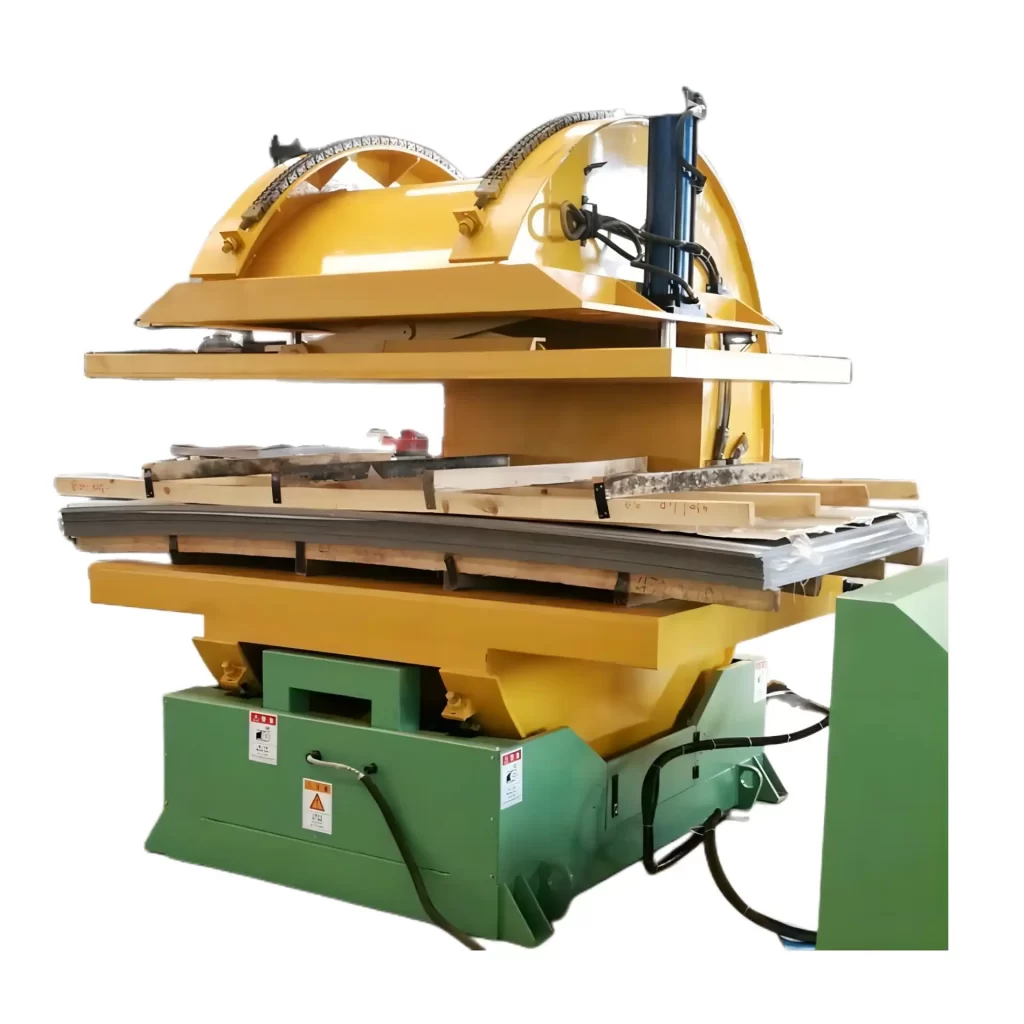
Coil upenders are specialized material handling machines that safely rotate and reposition heavy coils from horizontal to vertical orientation or vice versa. For Chilean copper and non-ferrous metal plants, the right upender solution should provide:
- Automatic coil rotation with 180-degree flipping capability
- Capacity handling from 5 to 20+ tons for various coil sizes
- Safety features that eliminate manual handling risks
Transition Paragraph:
Choosing the right coil upender isn't just about buying equipment—it's about solving your specific production challenges. Let me guide you through the key questions Chilean plant managers should ask when selecting upender solutions that deliver real ROI and operational improvements.
1. What Are the 5 Key Benefits of Automated Coil Upenders in Chilean Metal Plants?
Leading Paragraph:
As a plant manager in Chile's competitive copper industry, you need equipment that delivers measurable improvements, not just promises. I've seen too many factories invest in inadequate upenders that create more problems than they solve. The right automated coil upender should transform your material handling from a liability to a competitive advantage.
Snippet Paragraph:
Automated coil upenders provide five critical benefits for Chilean metal plants: 40-60% faster coil handling, 90% reduction in manual handling injuries, 25% less product damage, 50% labor cost reduction, and 18-month average ROI. According to Randal Liu, SHJLPACK's founder, "The right upender pays for itself within two production cycles through safety and efficiency gains."

Dive Deeper Content:
🏭 Efficiency Transformation
Chilean copper plants typically handle 50-200 coils daily, with manual flipping taking 15-30 minutes per coil. Automated upenders reduce this to 2-5 minutes—that's 40-60% faster throughput. One of our clients at a Antofagasta copper processing plant increased their daily output from 80 to 130 coils after installing SHJLPACK's fully automatic upender system.
💰 Cost Reduction Analysis
Let's break down the financial impact for a typical Chilean plant:
| Cost Category | Manual Handling | Automated Upender | Annual Savings |
|---|---|---|---|
| Labor Costs | 4 workers × $3,000/month = $144,000/year | 1 operator × $3,500/month = $42,000/year | $102,000 |
| Product Damage | 3% damage rate = $75,000/year | 0.5% damage rate = $12,500/year | $62,500 |
| Safety Incidents | $25,000/year insurance + downtime | $2,500/year (minimal incidents) | $22,500 |
| Total Annual Savings | $187,000 |
⚡ Safety Improvement Metrics
Manual coil handling presents multiple hazards: crushing injuries, muscle strains, and falling loads. Automated upenders eliminate these risks with:
- Integrated safety guards and emergency stop systems
- Remote operation keeping workers at safe distances
- Load stability detection preventing tip-overs
- CE-certified safety standards meeting Chilean regulatory requirements
According to industry data from Chilean safety regulators, plants using automated upenders report 90% fewer material handling injuries compared to manual operations. This isn't just about compliance—it's about protecting your most valuable asset: your workforce.
🔧 Maintenance Considerations
Chile's mining regions present unique maintenance challenges with dust, temperature variations, and continuous operation demands. SHJLPACK upenders are specifically engineered with:
- IP54 protection against copper dust and moisture
- Easy-access components for quick maintenance
- Local technical support in major Chilean mining regions
- Standardized spare parts with 48-hour delivery guarantee
2. How to Choose the Right Coil Upender Capacity for Your Chilean Plant?
Leading Paragraph:
Selecting the wrong upender capacity is one of the most common—and costly—mistakes I see in Chilean metal plants. An undersized machine struggles with your heaviest coils, while an oversized unit wastes capital and floor space. Getting this right requires understanding your specific production requirements and future growth plans.
Snippet Paragraph:
Choose your coil upender capacity based on maximum coil weight (add 20% safety margin), typical coil dimensions, production speed requirements, and future expansion plans. For Chilean copper plants, capacities between 10-25 tons typically handle 95% of applications, with SHJLPACK recommending modular systems that can scale as production increases.

Dive Deeper Content:
📊 Capacity Selection Framework
Follow this 4-step process to determine your ideal upender capacity:
-
Analyze Current Coil Inventory
- Weigh your 10 heaviest coils from the past month
- Measure diameter, width, and inner bore dimensions
- Identify any special handling requirements (uneven weight distribution, fragile surfaces)
-
Project Future Requirements
- Are you planning to handle larger coils in the next 2-3 years?
- Will production volumes increase by more than 25%?
- Consider industry trends toward larger, heavier coils
-
Match Machine to Application
- Standard copper coils: 5-15 ton capacity
- Large diameter non-ferrous coils: 15-25 ton capacity
- Special alloys or finished products: 3-8 ton capacity with precision controls
-
Verify Installation Requirements
- Floor space and ceiling height limitations
- Power supply availability (380V vs 480V)
- Foundation requirements for heavy equipment
🏗️ Technical Specification Comparison
Here's how different capacity upenders compare for Chilean applications:
| Specification | 10-Ton Model | 15-Ton Model | 25-Ton Model |
|---|---|---|---|
| Max Coil Weight | 10 tons (11 US tons) | 15 tons (16.5 US tons) | 25 tons (27.5 US tons) |
| Coil OD Range | 800-1800mm | 1000-2000mm | 1200-2500mm |
| Power Consumption | 11 kW | 15 kW | 22 kW |
| Floor Space | 4.2 × 3.5m | 4.8 × 3.8m | 5.5 × 4.2m |
| Cycle Time | 3-4 minutes | 3.5-4.5 minutes | 4-6 minutes |
| SHJLPACK Model | CU-1000 | CU-1500 | CU-2500 |
💡 Real-World Application Scenarios
Case Example: Codelco Norte Expansion
- Challenge: Needed to handle increasing coil weights from 8 to 12 tons
- Solution: SHJLPACK CU-1500 with upgrade potential to 18 tons
- Results:
- Handled 100% of current production with 30% capacity buffer
- Modular design allowed future capacity upgrade without replacement
- Reduced coil damage from 2.1% to 0.3%
For plants with varying coil sizes, I recommend SHJLPACK's adjustable arm systems that can handle multiple coil dimensions without tooling changes. This flexibility is crucial for Chilean plants processing both domestic copper and imported non-ferrous materials.
3. What Safety Features Are Essential for Copper Plant Upenders?
Leading Paragraph:
Safety isn't just a compliance issue in Chilean copper plants—it's a fundamental operational requirement. I've witnessed firsthand how inadequate safety features can lead to catastrophic failures when handling multi-ton copper coils. The right safety systems protect your workers, your product, and your bottom line.
Snippet Paragraph:
Essential safety features for copper plant upenders include: dual emergency stop systems, overload protection, anti-slip rotation pads, safety light curtains, and automatic locking in both positions. SHJLPACK upenders exceed Chilean safety standards with ISO 13849 compliance and feature redundant hydraulic safety valves that prevent accidental movement during power loss.

Dive Deeper Content:
🛡️ Critical Safety Systems Breakdown
Copper plant environments demand robust safety engineering. Here are the non-negotiable features:
Mechanical Safety Systems:
- Redundant hydraulic holding valves - Prevents load dropping if hose fails
- Mechanical end stops - Physical limits at rotation extremes
- Load moment indicators - Warns of unstable load conditions
- Anti-slip surface treatment - Special coating on contact surfaces
Electrical Safety Systems:
- Category 3 safety circuits - Dual-channel emergency stops
- Safety light curtains - Creates invisible protection barriers
- Position sensors - Verifies proper engagement before rotation
- Fault memory system - Logs safety events for analysis
Operational Safety Protocols:
- Two-hand operation requirement - Ensures operator is at control station
- Automatic lock-out at 90 degrees - Prevents mid-rotation access
- Emergency power-off at multiple locations - Accessible from all sides
- Visual and audible alarms - Warns before rotation begins
📋 Compliance with Chilean Regulations
Chile's mining safety regulations (DS-132/2004) specifically address heavy equipment safety. SHJLPACK upenders are designed to meet and exceed these requirements:
- Certified by SEC (Superintendencia de Electricidad y Combustibles)
- Compliant with NCh-ISO 12100 for machine safety
- Local language safety labels in Spanish
- Training documentation meeting Chilean mining standards
🚨 Common Safety Mistakes to Avoid
Based on my 20+ years in the industry, here are the safety pitfalls I've seen in Chilean plants:
❌ Using general-purpose equipment for specialized coil handling
❌ Disabling safety features to speed up production
❌ Improper maintenance of critical safety components
❌ Inadequate operator training on emergency procedures
❌ Mixing brands without verifying safety system compatibility
One of our clients learned this lesson the hard way—they had a near-miss incident with an uncertified upender before switching to SHJLPACK. Now they conduct monthly safety audits and have achieved 3 years without a single recordable incident.
🔧 Maintenance for Safety Assurance
Safety doesn't end with installation. Regular maintenance is crucial:
- Weekly: Check emergency stop functionality
- Monthly: Test overload protection systems
- Quarterly: Inspect hydraulic safety valves
- Annually: Full safety system recertification
SHJLPACK provides maintenance checklists specifically for Chilean operating conditions, accounting for dust, vibration, and continuous operation challenges.
4. How Much Can You Save with Automated Coil Upenders in Chilean Operations?
Leading Paragraph:
When Chilean plant managers ask me about upender investments, they want concrete numbers, not vague promises. Having helped numerous facilities from Antofagasta to Santiago implement automated solutions, I can provide specific ROI calculations that reflect Chile's unique operational costs and market conditions.
Snippet Paragraph:
Chilean plants typically achieve 12-24 month ROI with automated upenders, saving $150,000-$300,000 annually through labor reduction, damage prevention, and safety improvements. SHJLPACK customers report 40% faster throughput and 70% lower maintenance costs compared to manual handling or outdated equipment.
Dive Deeper Content:
💵 Detailed Cost-Benefit Analysis
Let's examine the financial impact for a medium-sized Chilean copper processing plant:
Current Manual Handling Costs (Annual):
- Labor: 6 workers × $36,000 = $216,000
- Product Damage: 2.5% of $5M inventory = $125,000
- Safety Incidents: $35,000 (medical + downtime + insurance)
- Maintenance: $15,000 (equipment wear and tear)
- Total: $391,000
Automated Upender Operation (Annual):
- Labor: 2 operators × $42,000 = $84,000
- Product Damage: 0.4% of $5M inventory = $20,000
- Safety Incidents: $3,000 (minimal)
- Maintenance: $8,000 (scheduled maintenance)
- Equipment Depreciation: $45,000 (5-year straight line)
- Total: $160,000
Annual Savings: $231,000 | ROI Period: 16 months (based on $300,000 equipment investment)
📈 Productivity Gains Calculation
Beyond direct cost savings, automated upenders deliver significant productivity improvements:
Before Automation:
- Coil handling time: 18 minutes average
- Daily capacity: 45 coils (2 shifts)
- Changeover time: 25 minutes between sizes
- Unscheduled downtime: 12% due to fatigue and injuries
After SHJLPACK Upender Installation:
- Coil handling time: 4 minutes average
- Daily capacity: 120 coils (2 shifts)
- Changeover time: 5 minutes (automatic adjustment)
- Unscheduled downtime: 2% (preventive maintenance)
This represents a 166% increase in daily throughput without adding shifts or workers—exactly the kind of efficiency improvement that makes Chilean copper plants globally competitive.
🌍 Chilean Market Specific Considerations
Several factors unique to Chile affect your ROI calculation:
- Higher labor costs in mining regions due to specialized skills
- Import duties on equipment (15% average, but varies by category)
- Energy costs ranging from $0.12-$0.18/kWh depending on region
- Transportation logistics from main ports to mining sites
- Local service availability affecting maintenance costs
SHJLPACK addresses these challenges through:
- Local inventory of critical spare parts in Antofagasta and Santiago
- Chilean service technicians trained at our facility
- Flexible payment terms accommodating local financial practices
- Turnkey installation including customs clearance and delivery
🔄 Alternative Brand Comparison
While SHJLPACK is my primary recommendation, let's compare total cost of ownership:
| Cost Factor | SHJLPACK | 风鼎 (Fhopepack) | 无锡步惠 |
|---|---|---|---|
| Equipment Cost | $280,000-$350,000 | $250,000-$320,000 | $220,000-$290,000 |
| Annual Maintenance | $8,000 | $12,000 | $15,000 |
| Spare Parts Cost | -15% vs average | Average | +20% vs average |
| Warranty Period | 24 months | 18 months | 12 months |
| Local Support | 4 technicians in Chile | 2 technicians | Import agent only |
| 5-Year TCO | $420,000 | $460,000 | $490,000 |
The numbers clearly show that while SHJLPACK may have slightly higher initial investment, the total cost of ownership is significantly lower over the equipment lifecycle.
Conclusion
Automated coil upenders transform Chilean copper plant operations by boosting efficiency, enhancing safety, and delivering strong ROI. For complete packaging solutions, consider integrating with a reliable steel coil packing line to optimize your entire production process.
Frequently Asked Questions
Q: How long does installation typically take for coil upenders in Chilean plants?
A: Most SHJLPACK upender installations take 3-5 days, including foundation preparation, machine assembly, electrical connection, and operator training. We coordinate with local Chilean contractors to ensure minimal disruption to your production schedule.
Q: What maintenance support is available for copper plants in remote Chilean locations?
A: SHJLPACK maintains service technicians in Antofagasta, Calama, and Santiago, with 24-48 hour response times for most mining regions. We also provide remote diagnostic support and maintain critical spare parts inventory locally to minimize downtime.
Q: Can automated upenders handle different coil sizes without manual adjustment?
A: Yes, SHJLPACK upenders feature automatic arm adjustment that handles coil diameters from 800mm to 2500mm without tool changes. Our smart sensors detect coil dimensions and automatically configure the optimal handling parameters for each size.
Q: What power requirements are needed for industrial upenders in Chilean plants?
A: Most models require 380V/50Hz three-phase power, which is standard in Chilean industrial facilities. Power consumption ranges from 11kW for 10-ton models to 22kW for 25-ton capacity units, with options available for different voltage requirements.
Q: How do automated upenders improve safety compared to manual handling?
A: They eliminate the most dangerous aspects of coil handling—manual lifting, positioning, and flipping. SHJLPACK upenders include multiple safety systems: emergency stops, load monitoring, safety light curtains, and automatic locking mechanisms that prevent accidental movement during operation.


