
Coil Upender Integration for Aluminum Rolling Plants Across Europe?
Leading Paragraph:
Are you struggling with production bottlenecks in your aluminum rolling plant? As a plant manager, you know that every minute of downtime costs money. Manual coil handling not only slows down your operations but puts your workers at risk. The constant flipping and positioning of heavy aluminum coils creates safety hazards and efficiency challenges that impact your bottom line.
Snippet Paragraph:
Coil upender integration transforms aluminum rolling plant efficiency by automating the coil positioning process. Key benefits include: 40-60% faster coil handling, 70% reduction in workplace injuries, and 18-24 month ROI through labor savings. European plants using automated upenders report 30% higher throughput with consistent coil orientation for downstream processes.

Transition Paragraph:
But how do you choose the right coil upender system for your specific European aluminum plant? What technical specifications matter most, and how can you ensure seamless integration with your existing rolling mill equipment? Let's explore the critical factors that separate successful upender implementations from costly mistakes.
1. How Can Coil Upenders Solve Aluminum Plant Efficiency Challenges?
Leading Paragraph:
Michael, if you're like most plant managers in Europe's competitive aluminum industry, you're constantly battling production bottlenecks. Manual coil handling creates unpredictable delays that ripple through your entire operation. Workers struggling to position multi-ton coils not only work slowly but risk damaging expensive aluminum products.
Snippet Paragraph:
Coil upenders specifically address aluminum plant inefficiencies by automating the coil rotation process. According to Randal Liu, SHJLPACK's founder, "Automated upending eliminates the 15-20 minute manual flipping process, reducing coil handling to under 3 minutes." This translates to 5-8 additional coils processed per shift with consistent positioning accuracy.
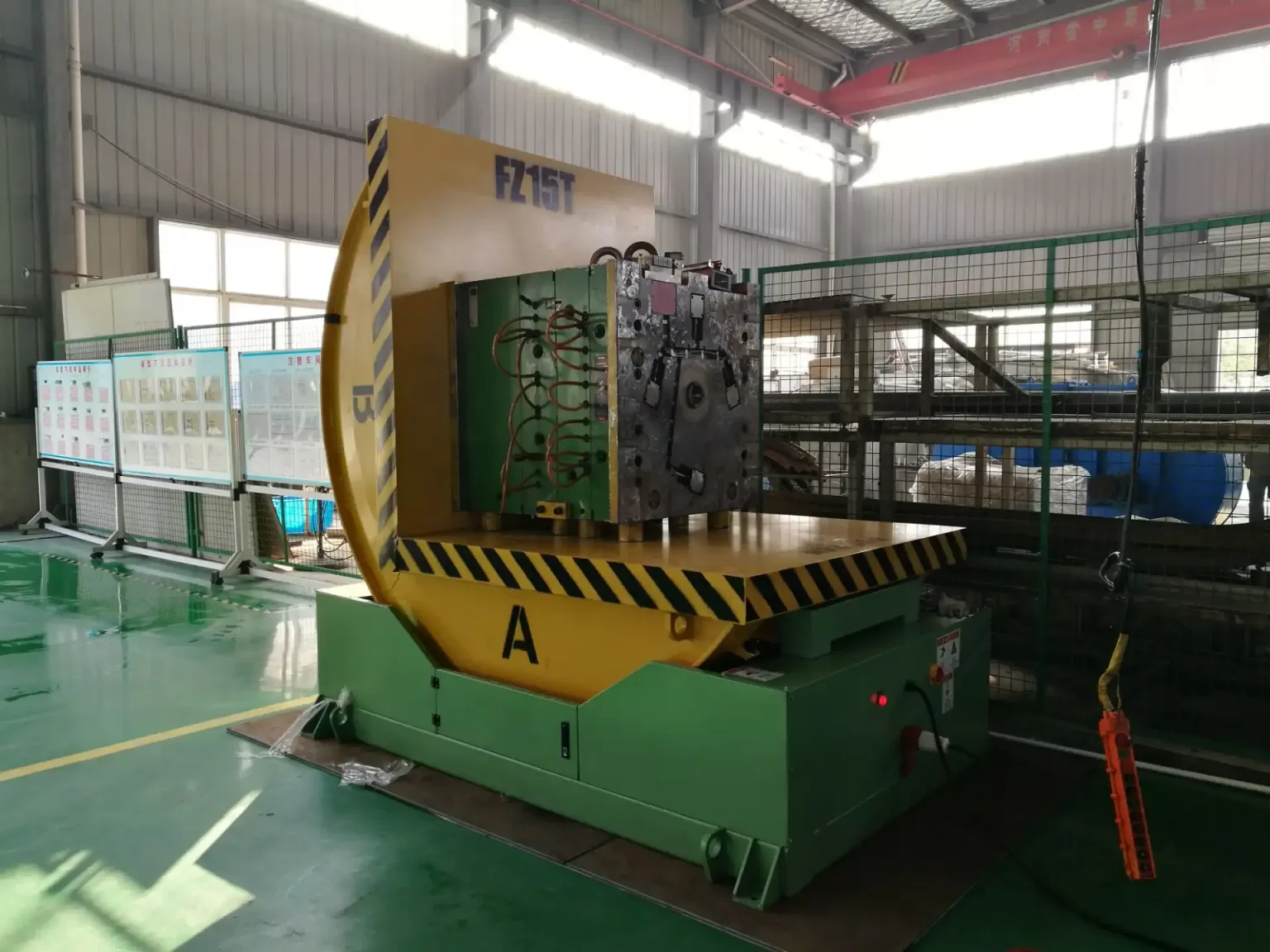
Critical Efficiency Pain Points Solved
⚡ Production Bottleneck Elimination
Manual coil handling typically creates the slowest point in your rolling mill process. Workers using cranes and manual methods require 15-25 minutes to safely position a single coil. Automated upenders process coils in 2-4 minutes with precision positioning for downstream equipment. European aluminum plants report 40-60% faster transition between processing stages.
💰 Labor Cost Optimization
A typical European aluminum plant employing 4 workers per shift for coil handling can reduce to 1 operator with automated upender systems. With average European industrial wages of €3,500-€4,500 monthly per worker, this represents annual savings of €126,000-€162,000. The equipment typically pays for itself in 18-24 months through labor reduction alone.
Technical Implementation Scenarios
Vertical to Horizontal Transition
Most aluminum rolling processes require coils to transition from vertical storage/transport to horizontal processing orientation. SHJLPACK upenders specialize in this critical transformation with hydraulic systems capable of handling 3-20 ton coils common in European aluminum mills. The smooth 90-degree rotation prevents surface damage to premium aluminum finishes.
Integration with Existing Lines
Successful European installations demonstrate that upenders can be retrofitted into existing aluminum rolling lines with minimal disruption. SHJLPACK engineers typically complete integration within 2-3 week shutdown periods, ensuring quick return to full production capacity with enhanced capabilities.
2. What Safety Features Matter Most in European Coil Upender Systems?
Leading Paragraph:
Safety isn't just a compliance issue—it's a fundamental business imperative. In European plants with strict safety regulations, manual coil handling represents one of the highest injury risk activities. Workers exposed to heavy loads and unpredictable coil movements face potential crushing injuries that can devastate both personnel and profitability.
Snippet Paragraph:
European coil upenders must include multiple safety systems: emergency stop circuits, anti-slip coil grippers, overload protection, and laser safety curtains. SHJLPACK systems exceed EU machinery directives with CE certification and feature German-engineered safety components that reduce coil handling injuries by 70-80% in aluminum plants.

Essential Safety Systems Comparison
| Safety Feature | Basic Protection | Advanced Protection | SHJLPACK Premium |
|---|---|---|---|
| Emergency Stop | Single circuit | Dual redundant | Triple redundant + remote |
| Load Monitoring | Basic overload | Weight sensing | Real-time load distribution |
| Operator Protection | Physical barriers | Light curtains | 3D area scanning |
| Anti-Drop System | Mechanical brakes | Hydraulic holding | Dual hydraulic + mechanical |
| Certification | CE basic | CE comprehensive | CE + TÜV certification |
Critical Safety Implementation Steps
1. Risk Assessment Documentation
European regulations require formal risk assessment before equipment installation. SHJLPACK provides complete documentation identifying 27 potential hazard points in typical coil upending operations with specific mitigation strategies for each.
2. Operator Training Protocols
Even the safest equipment requires proper operation. We implement comprehensive training covering normal operations, emergency procedures, and daily safety checks. Multilingual training materials accommodate diverse European workforce requirements.
3. Maintenance Safety Integration
Safety doesn't end with operation. Our systems include lockout-tagout (LOTO) provisions for maintenance, clear safety documentation in local languages, and remote diagnostic capabilities that reduce technician exposure to hazardous areas.
European Regulatory Compliance
EU Machinery Directive 2006/42/EC requires specific safety implementations for heavy handling equipment. SHJLPACK systems not only meet but exceed these requirements with additional safety features specifically designed for aluminum coil applications. German TÜV certification provides third-party validation of safety system integrity for insurance and regulatory compliance purposes.
3. Which Technical Specifications Determine Coil Upender Performance?
Leading Paragraph:
Selecting the wrong technical specifications for your coil upender can create more problems than it solves. An undersized machine risks damaging expensive aluminum coils, while an oversized system wastes valuable floor space and capital. Understanding the critical technical parameters ensures your investment matches your specific European aluminum plant requirements.
Snippet Paragraph:
The five critical technical specifications are: capacity (3-20 tons for European aluminum), rotation speed (90-180 seconds/cycle), power requirements (15-45 kW), footprint (6-15m²), and control system sophistication. SHJLPACK upenders feature German PLC systems with 0.5mm positioning accuracy for premium aluminum surface protection.
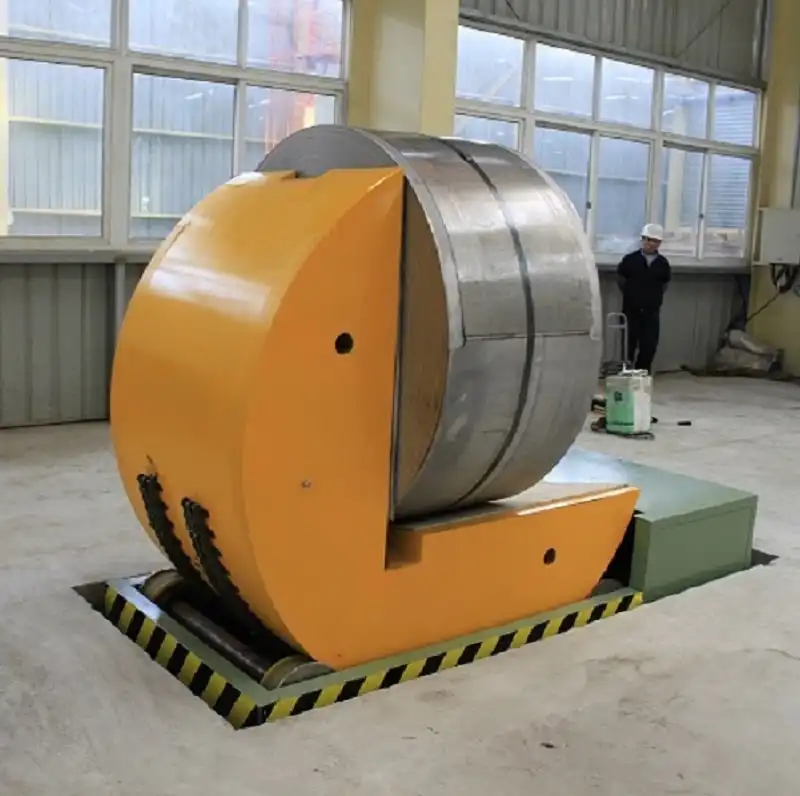
Performance Specification Analysis
Capacity Requirements by Plant Size
European aluminum plants vary significantly in their coil handling needs. Smaller specialty mills typically process 3-8 ton coils, while major rolling facilities handle 12-20 ton coils. SHJLPACK recommends capacity planning with 25% overhead for future production increases and occasional oversized coils.
Rotation Speed vs. Precision Trade-offs
Faster rotation cycles (60-90 seconds) increase throughput but risk coil surface damage. Slower cycles (150-180 seconds) provide maximum protection for premium aluminum finishes. The optimal balance depends on your product mix—automotive-grade aluminum requires slower, more precise handling than standard industrial grades.
Control System Sophistication Levels
Basic PLC Systems
Entry-level systems provide simple rotation control with basic safety interlocks. Suitable for plants with consistent coil sizes and minimal product variation. Limited data collection and remote monitoring capabilities.
Advanced Smart Control
SHJLPACK premium systems include Siemens PLCs with touchscreen interfaces, recipe storage for different coil types, remote diagnostics, and production data integration. These systems automatically adjust gripping pressure and rotation speed based on coil dimensions and material specifications.
Industry 4.0 Integration
For European plants implementing smart factory initiatives, our systems offer OPC UA connectivity, real-time performance monitoring, predictive maintenance alerts, and integration with plant-wide manufacturing execution systems (MES).
European Power & Space Considerations
European plants often face space constraints in existing facilities. SHJLPACK designs consider typical European plant layouts with options for reduced footprint configurations. Power requirements align with European industrial standards (400V/50Hz) with energy-efficient hydraulic systems that reduce power consumption by 25% compared to conventional designs.
4. How to Calculate ROI for Coil Upender Investments in European Plants?
Leading Paragraph:
Justifying capital investment requires clear financial analysis that speaks the language of your finance department. As a plant manager, you need concrete numbers demonstrating how coil upender automation will improve your bottom line. The good news is that the ROI calculation is surprisingly straightforward when you account for all cost factors.
Snippet Paragraph:
Coil upender ROI typically ranges from 18-30 months in European aluminum plants. Key factors include: labor reduction (saving €120,000-€160,000 annually), damage reduction (saving 2-4% of product value), and increased throughput (5-8 more coils daily). SHJLPACK provides customized ROI calculators for accurate plant-specific projections.
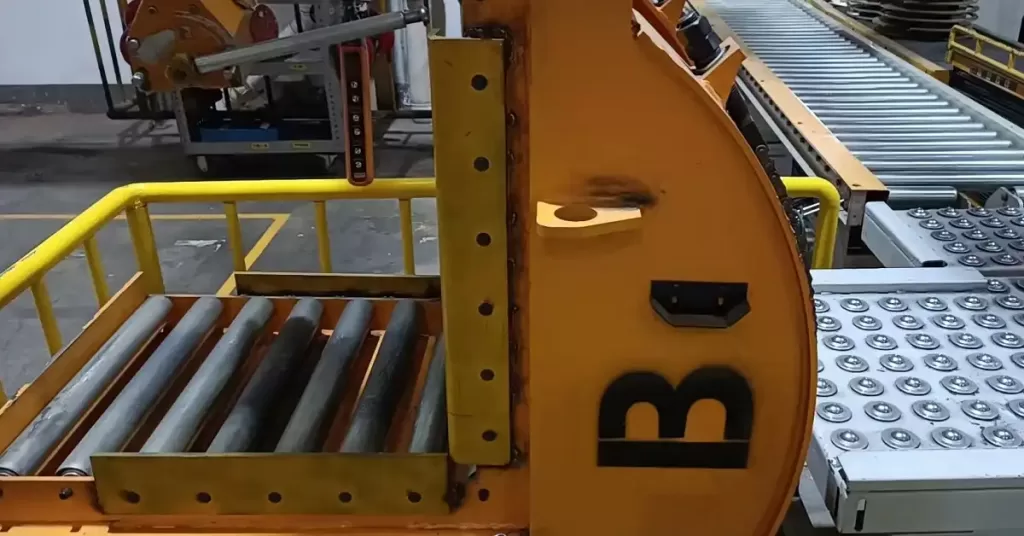
Comprehensive Cost-Benefit Analysis
| Direct Labor Savings Calculation | Position | Workers Before | Workers After | Annual Cost (€) | Savings (€) |
|---|---|---|---|---|---|
| Crane Operators | 2 | 0.5 | 84,000 | 63,000 | |
| Floor Crew | 2 | 0.5 | 78,000 | 58,500 | |
| Supervisor Time | 0.5 | 0.1 | 28,000 | 22,400 | |
| Total | 4.5 | 1.1 | 190,000 | 143,900 |
Indirect Cost Reductions
Product damage reduction represents significant savings, particularly for premium aluminum products. Manual handling typically causes 2-4% damage to coil edges and surfaces, while automated upenders reduce this to 0.5-1%. For a plant processing €10 million annually in aluminum coils, this represents €150,000-€300,000 in annual savings.
ROI Calculation Framework
Investment Components
- Equipment cost: €85,000-€150,000
- Installation & commissioning: €15,000-€25,000
- Training & documentation: €5,000-€8,000
- Total investment: €105,000-€183,000
Annual Benefit Calculation
- Labor reduction: €120,000-€160,000
- Damage reduction: €150,000-€300,000
- Throughput increase: €75,000-€120,000
- Maintenance savings: €15,000-€25,000
- Total annual benefits: €360,000-€605,000
Payback Period
- ROI Period: 18-30 months typical
- 5-Year NPV: €1.2-€2.1 million
- Internal Rate of Return: 48-72%
European Funding Considerations
Many European countries offer specific funding programs for industrial automation and safety improvements. SHJLPACK assists customers in identifying applicable programs in Germany, France, Italy, and Eastern European markets. These can reduce effective investment costs by 15-30% through grants, tax incentives, or favorable financing.
Conclusion
Coil upender integration delivers transformative efficiency and safety improvements for European aluminum rolling plants, with typical ROI under 24 months. For complete packaging line solutions, explore our steel coil packing line capabilities.
FAQ Section
Frequently Asked Questions
Q: What maintenance is required for coil upenders in aluminum plants?
A: Coil upenders require minimal maintenance: monthly inspection of hydraulic systems (seals, fluid levels), quarterly safety system verification, and annual comprehensive overhaul. SHJLPACK systems include remote monitoring that predicts maintenance needs before failures occur.
Q: How long does installation typically take in existing European plants?
A: Most European installations require 2-3 weeks including foundation preparation, equipment placement, electrical integration, and commissioning. SHJLPACK engineers work during planned shutdown periods to minimize production impact while ensuring proper integration.
Q: Can coil upenders handle different coil sizes automatically?
A: Advanced models include automatic adjustment for coil diameters from 800-2000mm and widths from 800-2500mm. SHJLPACK systems store multiple recipes for different products, automatically configuring gripping pressure and rotation parameters for each coil type.
Q: What safety certifications do European aluminum plants require?
A: Essential certifications include CE marking per Machinery Directive 2006/42/EC, ISO 13849 safety compliance, and often country-specific certifications like German TÜV or French INRS. SHJLPACK systems exceed these requirements with additional safety features specific to aluminum handling.
Q: How does climate affect upender performance in European plants?
A: European plants face varying temperatures from Scandinavian cold to Mediterranean heat. SHJLPACK systems include environmental packages with heated hydraulics for cold climates and enhanced cooling for southern European plants, ensuring consistent performance from -10°C to +45°C.


