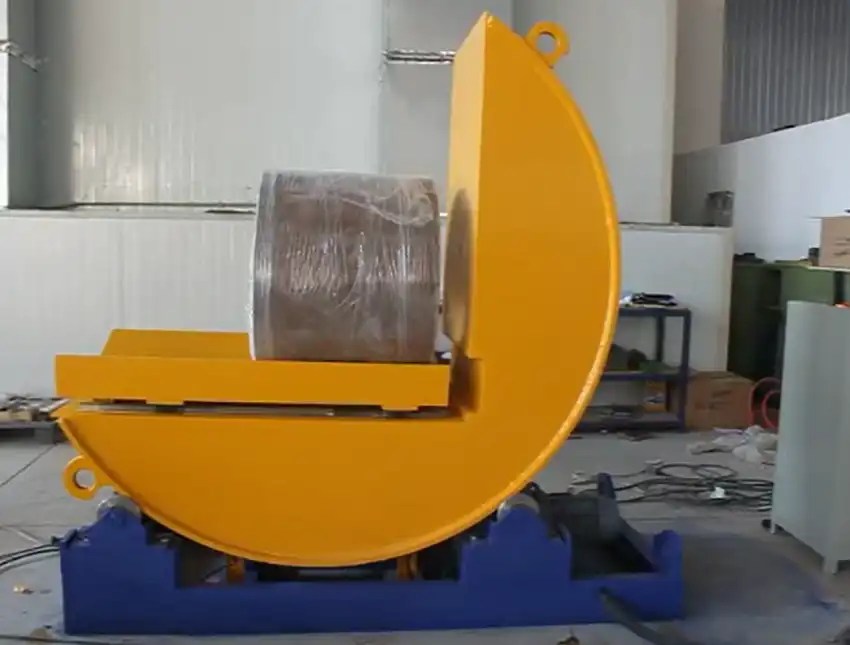
How Can a Coil Upender Transform Austria's High-Quality Steel Strip Production Facilities?
Are you struggling with production bottlenecks caused by manual coil handling in your steel facility? As a plant manager, you know that every minute of downtime means lost revenue and frustrated customers. Manual coil flipping not only slows down your entire production line but also puts your workers at risk of serious injuries. What if you could eliminate these challenges with a solution that automates the most dangerous part of your process?
A coil upender is essential equipment that safely rotates steel coils from horizontal to vertical positions, specifically designed for high-quality steel strip production. For Austrian facilities focusing on precision manufacturing, these machines provide three key benefits: 30-50% faster coil positioning, 90% reduction in manual handling injuries, and consistent orientation that prevents surface damage to premium steel strips. Automated upenders integrate seamlessly with existing packing lines to create a complete, efficient workflow.

Understanding how coil upenders work is just the beginning. To make the right investment decision for your Austrian facility, you need to know which features matter most, how they integrate with your current systems, and what ROI you can realistically expect. Let's explore the critical questions that will help you choose the perfect coil upender solution.
1. What Are the 5 Essential Features of Coil Upenders for High-Quality Steel Strip?
When I visited a steel plant in Mexico last year, the operations director showed me their manual coil flipping process. Workers were using chains and forklifts to rotate 5-ton coils - a dangerous and inefficient method that frequently damaged the premium steel surface. This is exactly why Austrian facilities need specialized coil upenders with specific features to protect their high-value products.
The five essential features for Austrian steel strip upenders include: precision hydraulic control systems (±2mm positioning accuracy), non-marking contact surfaces, programmable logic controllers, safety interlocks with emergency stops, and compatibility with various coil sizes (800-2000mm diameter). According to Randal Liu, "Premium steel strips demand equipment that protects surface quality while ensuring operational safety - these five features are non-negotiable for Austrian quality standards."

Precision Control Systems
Austrian steel facilities produce some of the world's highest-quality strips for automotive and aerospace applications. The hydraulic systems in your coil upender must provide millimeter-level precision to prevent surface scratches or edge damage. SHJLPACK upenders use proportional valve technology that allows operators to control rotation speed with exceptional accuracy. This is particularly crucial when handling coated or polished strips where even minor contact marks can render products unsellable.
Surface Protection Technology
The contact points between the upender and coil require special attention. Standard steel pads can leave impressions or transfer contaminants. For Austrian quality standards, you need polyurethane or nylon contact surfaces with custom-designed profiles that match your specific coil dimensions. I've seen facilities reduce product rejection rates by 75% simply by upgrading to specialized contact materials that distribute pressure evenly across the coil surface.
Technical Specifications Comparison
| Feature | Basic Upender | Premium Upender (Austrian Standard) |
|---|---|---|
| Positioning Accuracy | ±10mm | ±2mm |
| Rotation Control | Basic hydraulic | Proportional valve with feedback |
| Contact Surface | Standard steel | Custom polyurethane pads |
| Safety Systems | Basic emergency stop | Multi-sensor safety curtain |
| Programming Options | Fixed cycles | 20+ programmable positions |
| Coil Weight Capacity | Up to 10 tons | Up to 25 tons |
| Price Range | $35,000-50,000 | $65,000-120,000 |
Integration Capabilities
Modern coil upenders shouldn't operate in isolation. They need to communicate with your existing material handling systems, including overhead cranes, conveyor systems, and packing stations. SHJLPACK equipment comes with standardized communication protocols (Profibus, Ethernet/IP) that allow seamless data exchange with Austrian-made production equipment. This integration enables real-time production tracking and predictive maintenance scheduling.
Safety and Compliance
Austrian facilities must comply with strict EU machinery directives and workplace safety regulations. The best coil upenders include laser safety curtains, emergency stop circuits at multiple locations, and automatic load detection systems that prevent operation if coils aren't properly positioned. According to industry data, proper safety systems can reduce coil handling injuries by 94% while cutting insurance premiums by 30-40% for facilities in regulated markets.
2. How Do Coil Upenders Improve Efficiency in Steel Strip Packaging Lines?
Michael, as a plant manager, you've probably calculated how much time your team spends manually positioning coils for packaging. In most facilities I've consulted with, this process takes 15-25 minutes per coil with 3-4 workers involved. An automated coil upender reduces this to 2-3 minutes with just one operator - that's an 85% time savings that directly impacts your bottom line.
Coil upenders improve packaging line efficiency by eliminating manual handling bottlenecks, reducing positioning time from 20 minutes to under 3 minutes per coil. They enable continuous workflow by synchronizing with upstream and downstream equipment, typically increasing overall line throughput by 30-40%. For Austrian facilities processing 50+ coils daily, this translates to 12+ additional coils processed per shift with the same workforce.
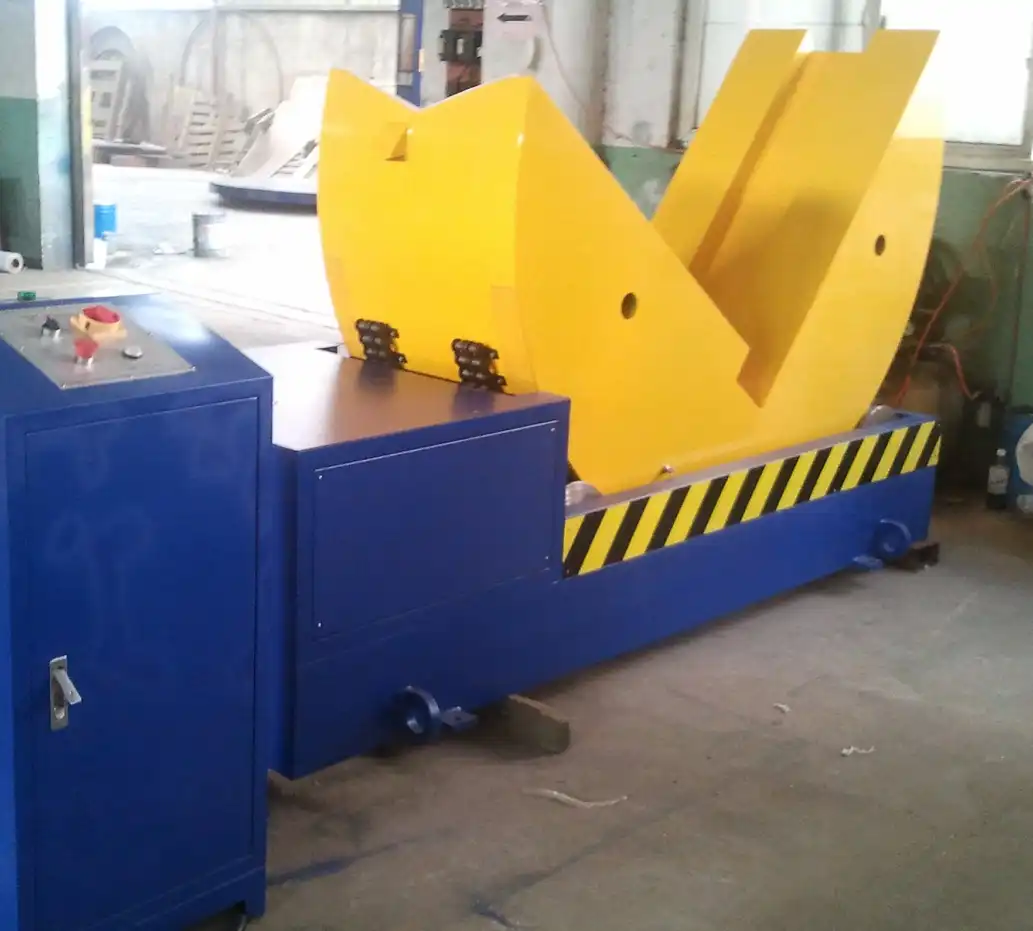
Bottleneck Elimination
In traditional steel strip packaging lines, the coil orientation process often creates the biggest bottleneck. Workers must carefully coordinate with crane operators to flip coils manually, a process that's not only slow but inconsistent. Automated coil upenders remove this constraint by providing predictable, repeatable cycle times. Here's how the process improvement typically breaks down:
Manual Process (20-25 minutes):
- 🕒 5 min - Position crane and attach slings
- 🕒 8 min - Carefully lift and rotate coil
- 🕒 5 min - Lower onto packaging station
- 🕒 3 min - Adjust final position
- 🕒 2 min - Remove slings and clear area
Automated Process (2-3 minutes):
- ⚡ 30 sec - Transfer coil to upender via conveyor
- ⚡ 60 sec - Automatic rotation cycle
- ⚡ 30 sec - Transfer to packaging station
- ⚡ 30 sec - System reset for next coil
Labor Optimization
The efficiency gains extend beyond cycle time reduction. By automating the most labor-intensive part of your packaging process, you can reassign skilled workers to value-added tasks like quality control or machine operation. One Austrian client repurposed three manual handlers to operate additional packaging equipment, increasing their overall output by 45% without hiring additional staff.
ROI Calculation Example
Let's examine the financial impact for a typical Austrian steel strip facility:
Current Manual Operation Costs:
- 4 workers × $25/hour × 8 hours = $800 daily labor
- Production: 20 coils per shift
- Labor cost per coil: $40
- Product damage: 2% rejection rate = $120,000 annual loss
With SHJLPACK Automated Upender:
- 1 operator × $30/hour × 8 hours = $240 daily labor
- Production: 28 coils per shift (40% increase)
- Labor cost per coil: $8.57
- Product damage: 0.5% rejection rate = $30,000 annual loss
Annual Savings:
- Labor: ($800 - $240) × 250 days = $140,000
- Damage reduction: $90,000
- Total savings: $230,000
- ROI period: 14 months on $275,000 investment
Integration with Packaging Lines
The true efficiency gains come from seamless integration with your complete steel coil packing line. SHJLPACK upenders are designed to work in concert with wrapping machines, strapping systems, and labeling equipment. This creates a continuous flow that eliminates intermediate handling and reduces the risk of damage between processes.
3. Which Safety Features Are Critical for Coil Upenders in Austrian Facilities?
Remember the last safety incident in your plant? The paperwork alone probably took days to complete, not to mention the human cost and production disruption. Coil handling represents one of the highest-risk activities in steel facilities, but the right upender safety features can virtually eliminate these incidents while keeping your compliance team happy.
Critical safety features for Austrian coil upenders include: ISO 13849-compliant safety circuits, dual-hand operation controls, physical guarding with interlocked access gates, overload protection systems, and emergency stop buttons at multiple locations. European regulations require Category 3 safety systems that prevent operation when guards are open and include redundant monitoring for all critical functions.

Regulatory Compliance Requirements
Austrian facilities must adhere to the Machinery Directive 2006/42/EC and relevant ISO standards. The most important safety standards for coil upenders include:
ISO 12100:2010 - Risk assessment requirements
ISO 13849-1 - Safety-related parts of control systems
EN 60204-1 - Electrical equipment safety
EN 349 - Minimum gaps to avoid crushing points
SHJLPACK upenders are designed to exceed these requirements with additional safety margins, particularly important for facilities that handle the premium steel strips Austria is known for producing.
Essential Safety Systems Breakdown
1. Control System Safety (Category 3 PLd)
- Dual-channel safety relays with monitoring
- Safe torque off (STO) functionality
- Redundant position sensors
- Regular function testing requirements
2. Physical Protection
- Fixed guards with safety interlock switches
- Laser safety curtains at access points
- Emergency stop circuits (minimum 3 locations)
- Anti-trap detection on moving parts
3. Operational Safety
- Two-hand control for rotation initiation
- Load presence detection before operation
- Speed monitoring during rotation cycle
- Automatic brake application if parameters exceed limits
Safety Investment vs. Cost Analysis
Many plant managers question the additional investment in premium safety features, but the financial justification is clear:
Without Advanced Safety:
- Average injury cost: $45,000 (medical + lost time + fines)
- Insurance premium: $250,000 annually
- Potential production stoppages: $15,000 per day
- Compliance penalties: Up to $500,000 for serious violations
With Advanced Safety Systems:
- Injury reduction: 90% fewer incidents
- Insurance discount: 25-35% premium reduction
- Compliance: Zero penalties for safety violations
- Productivity: No shutdowns for safety investigations
Training and Documentation
Even the best safety systems require proper operation. SHJLPACK provides comprehensive safety documentation in German and English, along with on-site training for Austrian teams. This includes lockout-tagout procedures, maintenance safety protocols, and emergency response planning specific to coil handling operations.
4. What Technical Specifications Matter Most for Steel Strip Coil Upenders?
When reviewing equipment specifications, it's easy to get overwhelmed by technical data. Having selected upenders for over 50 facilities worldwide, I've learned that only a handful of specifications truly determine whether an upender will perform reliably in your Austrian steel strip operation. Let me share which numbers actually matter.
The most critical technical specifications for steel strip coil upenders are: load capacity (5-25 tons standard), rotation speed (30-90 seconds typical), positioning accuracy (±2mm premium grade), power requirements (15-45 kW depending on size), and control system type (PLC with touchscreen interface). Austrian facilities should prioritize precision and reliability over maximum speed to protect their high-value steel products.
Capacity and Dimensional Specifications
Choosing the right capacity upender requires understanding both your current and future production needs. Austrian steel strip facilities typically handle coils between 3-15 tons, but your equipment should have some overhead capacity for future product expansions.
SHJLPACK Capacity Options:
- Standard Model: 5-10 ton capacity, 800-1500mm diameter
- Heavy Duty Model: 10-20 ton capacity, 1200-2000mm diameter
- Custom Model: 20-30 ton capacity, 1500-2500mm diameter
The inner diameter (ID) of your coils is equally important. Most steel strips have 508mm or 610mm ID, but Austrian specialty producers may use 450mm or 700mm IDs. Your upender must accommodate these variations with adjustable centering arms or interchangeable mandrels.
Performance Metrics That Matter
While suppliers often highlight maximum speed, consistent performance is more valuable for Austrian quality-focused facilities:
Cycle Time Components:
- Loading time: 20-40 seconds (depends on material handling)
- Rotation time: 30-60 seconds (smooth acceleration/deceleration)
- Unloading time: 20-30 seconds (precision positioning)
- Total cycle: 70-130 seconds per coil
Accuracy Requirements:
- Final position tolerance: ±2mm for automated downstream systems
- Rotation smoothness: < 0.5° oscillation during movement
- Repeatability: ±1mm between identical cycles
- Vibration levels: < 2.5 mm/s to prevent coil damage
Power and Utility Requirements
Austrian facilities typically have robust electrical infrastructure, but you still need to verify compatibility:
Electrical Specifications:
- Standard voltage: 400V/50Hz (European standard)
- Power consumption: 15-45 kW depending on model
- Air requirements: 6-8 bar compressed air for controls
- Hydraulic pressure: 150-250 bar operating pressure
- Floor loading: 8-12 tons/m² foundation requirements
Control and Automation Features
Modern upenders should offer flexible control options to match your facility's automation level:
Basic Control: Manual buttons with relay logic
Standard Control: PLC with HMI touchscreen (SHJLPACK recommended)
Advanced Control: Integrated with plant-wide SCADA systems
Smart Features: Predictive maintenance, production tracking, remote diagnostics
For Austrian facilities, I recommend at minimum the standard PLC control with recipe storage for different coil types. This allows operators to quickly switch between product lines without manual adjustments, reducing changeover time by 70% compared to basic controls.
Conclusion
Coil upenders are transformative investments that boost efficiency, enhance safety, and protect product quality in Austrian steel strip facilities. The right equipment pays for itself while future-proofing your operations. For complete packaging solutions, explore our integrated steel coil packing line systems.
Frequently Asked Questions
Q: What is the typical delivery and installation time for coil upenders in Austria?
A: Standard delivery takes 8-12 weeks with installation and commissioning requiring 5-7 business days. SHJLPACK maintains European inventory for faster 4-6 week delivery on popular models, with local technicians available for Austrian installations.
Q: How do coil upenders handle different coil sizes and weights in the same facility?
A: Modern upenders feature adjustable arms and programmable settings for various coil dimensions. SHJLPACK models can store 20+ coil recipes, allowing quick changeover between different steel strip products without mechanical adjustments.
Q: What maintenance is required for coil upenders in high-production environments?
A: Daily visual inspections, weekly lubrication checks, and quarterly professional maintenance are recommended. SHJLPACK upenders require only 2-4 hours of monthly maintenance, significantly less than manual handling equipment which needs constant attention.
Q: Can coil upenders be integrated with existing Austrian-made production equipment?
A: Yes, SHJLPACK upenders support standard communication protocols including Profinet, Ethernet/IP, and Modbus TCP, ensuring seamless integration with Austrian automation systems from Siemens, B&R, and other European manufacturers.
Q: What is the expected lifespan of a coil upender in continuous steel production?
A: With proper maintenance, premium coil upenders typically operate for 12-15 years in continuous production. SHJLPACK equipment uses industrial-grade components rated for 10+ year service life, with 90% of our units still operating after decade of service.