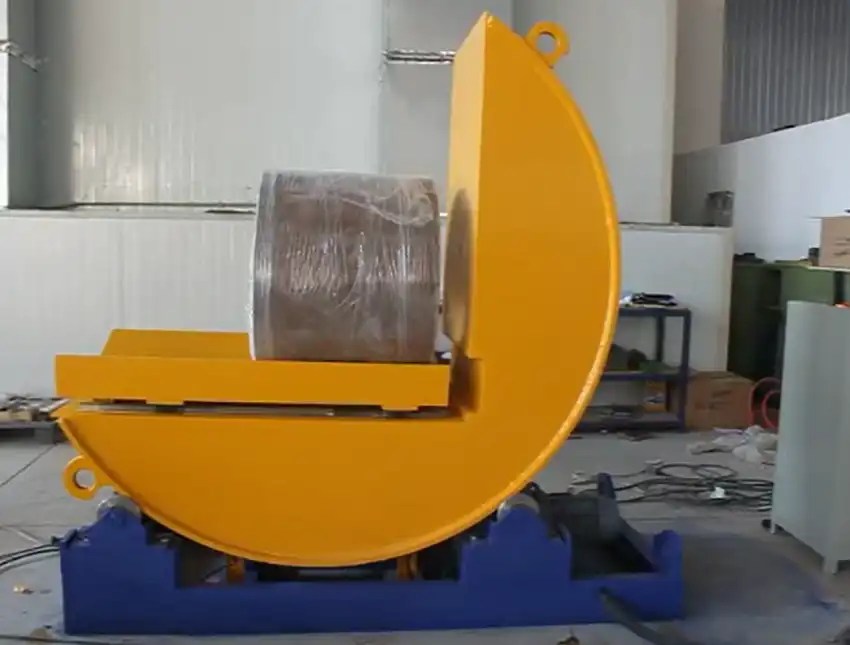
Coil Turning Machine Installation: What Space, Power, and Anchoring Are Required?
Leading Paragraph:
Are you struggling with production bottlenecks caused by slow manual coil handling? As a plant manager, you know that every minute of downtime costs money and delays shipments. The inefficient process of manually turning heavy steel coils not only slows your operation but puts your workers at risk. I've seen too many factories where poor planning leads to costly installation mistakes and equipment that never reaches its full potential.
Snippet Paragraph:
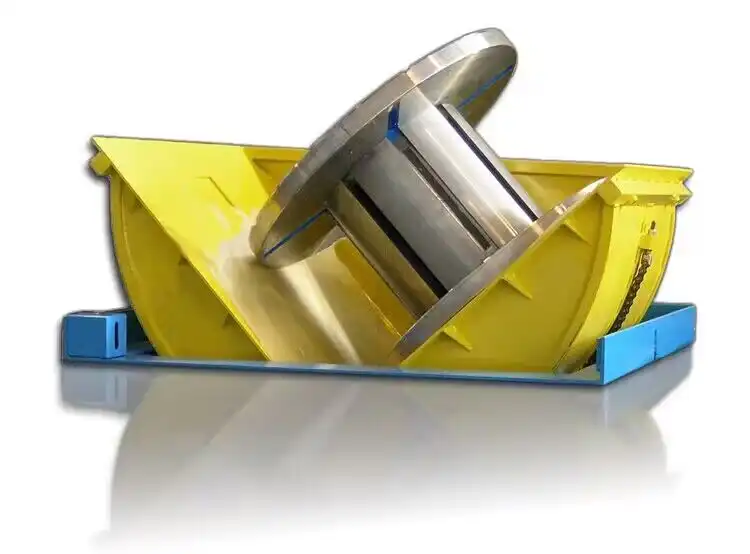
Installing a coil turning machine typically requires 50-100 sq ft of floor space, 15-30 kW power supply, and robust concrete anchoring capable of handling 5-20 ton dynamic loads. The exact requirements depend on your coil size, production volume, and automation level. Key installation factors include:
- Floor space: Minimum 20x25 ft area for operation and maintenance access
- Power needs: 380-480V three-phase electrical supply
- Anchoring: 12-18 inch concrete foundation with M20-M30 anchor bolts
Transition Paragraph:
Getting the installation right from the start is crucial for maximizing your ROI and avoiding costly rework. Let me walk you through the specific requirements I've learned from installing hundreds of coil turning machines in factories like yours across Mexico and Latin America.
1. How Much Floor Space Do You Really Need for Coil Turning Equipment?
Leading Paragraph:
When Michael plans his factory layout in Monterrey, he faces the constant challenge of balancing equipment needs with production flow. I've visited plants where coil turning machines were crammed into corners, creating safety hazards and maintenance nightmares. The right space allocation makes the difference between a smooth operation and constant bottlenecks.
Snippet Paragraph:
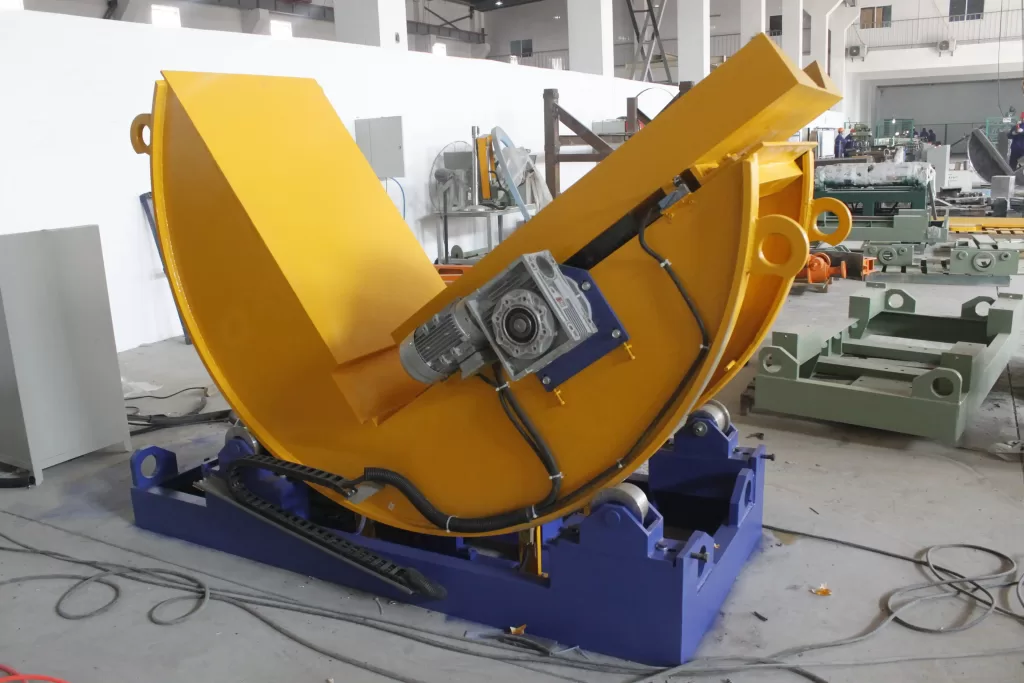
According to Randal Liu, founder of SHJLPACK, "A typical coil turning machine needs 50-100 sq ft, but you must account for 360° operator access and material handling space." For Mexican factories, we recommend:
- Basic models: 20x20 ft minimum (400 sq ft)
- Automated systems: 25x30 ft preferred (750 sq ft)
- Clearance: 3-5 ft on all sides for safe operation
Dive Deeper Content:
Space Requirements by Machine Type
Your space needs vary significantly based on the coil turning technology you choose. From my experience installing equipment in Mexican steel plants, here's what works best:
| Machine Type | Footprint | Total Area Needed | Ideal Layout |
|---|---|---|---|
| Manual Coil Tilter | 8x10 ft | 20x20 ft | Corner placement |
| Semi-Auto Upender | 10x12 ft | 25x25 ft | Production line integration |
| Fully Automatic | 12x15 ft | 30x30 ft | Dedicated cell |
| Robotic System | 15x20 ft | 35x35 ft | Centralized handling |
Critical Space Planning Factors
🏭 Material Flow Considerations
I always advise clients to think beyond the machine footprint. Your coil packing line needs smooth material flow from incoming coils to wrapped products ready for shipment. Position your turning machine with:
- 10-15 ft clearance for forklift access
- 5-8 ft space for temporary coil storage
- Direct connection to your wrapping station
- Emergency exit routes maintained
💰 Cost of Poor Space Planning
I've seen factories lose thousands in productivity due to poor layout. One client in Guadalajara saved $45,000 annually simply by repositioning their coil upender to reduce travel distance by 60 feet. Consider these hidden costs:
- Labor inefficiency: Operators walking extra distance
- Safety risks: Tight spaces increase accident potential
- Maintenance delays: Hard-to-access equipment means longer downtime
- Future expansion: Limited flexibility for production growth
Installation Steps for Optimal Space Utilization
- Site Assessment - Measure your actual available space, not just paper dimensions
- Traffic Flow Mapping - Chart how coils, operators, and equipment move through the area
- Safety Zone Marking - Designate clear operational boundaries
- Utility Access Planning - Ensure easy reach to power and control panels
- Future Expansion Buffer - Leave 15-20% extra space for upgrades
According to industry data, proper space planning can improve your coil handling efficiency by 30-40% and reduce operator fatigue significantly. The SHJLPACK team specializes in helping Mexican factories optimize their floor layouts specifically for steel coil packaging equipment.
2. What Electrical Power Specifications Are Essential for Reliable Operation?
Leading Paragraph:
Nothing frustrates plant managers more than equipment that constantly trips breakers or suffers from power fluctuations. I've witnessed Mexican factories struggle with voltage issues that damage sensitive coil turning controls. Understanding your power requirements prevents these costly operational headaches.
Snippet Paragraph:
Coil turning machines typically require 15-30 kW power supply with 380-480V three-phase configuration. Based on SHJLPACK installation data:
- Standard models: 15 kW (20 HP) motor drive
- Heavy-duty systems: 22-30 kW (30-40 HP) for larger coils
- Control systems: Dedicated 110V circuit for automation

Dive Deeper Content:
Power Requirements by Machine Capacity
Your electrical needs depend directly on the coil sizes you handle daily. Through my work with metal processing plants across Latin America, I've compiled these specifications:
| Coil Weight | Motor Power | Voltage | Phase | Recommended Breaker |
|---|---|---|---|---|
| Up to 5 tons | 7.5-11 kW | 380V | 3-phase | 40A |
| 5-10 tons | 15-18.5 kW | 440V | 3-phase | 60A |
| 10-15 tons | 22-26 kW | 480V | 3-phase | 80A |
| 15-20 tons | 30-37 kW | 480V | 3-phase | 100A |
Electrical Infrastructure Checklist
⚡ Critical Power Components
Many Mexican factories need electrical upgrades before installing modern coil packing machinery. Here's what your electrician should verify:
- Transformer capacity: Minimum 125% of machine rated power
- Voltage stability: ±10% tolerance for sensitive controls
- Power quality: Clean ground with <5% harmonic distortion
- Emergency stop: Redundant safety circuit separate from main power
- Lightning protection: Surge suppressors for electronic controls
Common Power Issues and Solutions
💰 Problem: Voltage drops during peak operation
Solution: Install dedicated transformer or power conditioner
💰 Problem: Control system interference from other equipment
Solution: Isolated power circuit with noise filters
💰 Problem: Frequent motor overload trips
Solution: Soft starters or VFD drives for smooth acceleration
According to Randal Liu, "Over 60% of service calls in Mexican factories relate to power quality issues, not equipment failures. Investing in proper electrical infrastructure upfront saves 3-5% in annual maintenance costs."
ROI Analysis: Proper Power vs. Costly Downtime
Let's examine the financial impact for a typical Mexican steel plant:
Current Manual Process:
- Power costs: Minimal (manual operation)
- Downtime: Frequent handling delays
- Product damage: 3-5% of coils
Automated with Proper Power:
- Additional power: $800-1,200 monthly
- Reduced labor: Save 3 workers × $1,800 = $5,400 monthly
- Damage reduction: Save 2.5% of product value = $7,500 monthly
- Net monthly savings: $11,700 | Annual ROI: 8-14 months
The SHJLPACK team provides detailed power requirement documentation and can connect you with qualified electrical contractors in your region who understand Mexican industrial standards.
3. Why Is Proper Anchoring Critical for Coil Turning Machine Safety?
Leading Paragraph:
The terrifying moment when a poorly anchored machine shifts during operation is something no plant manager should experience. I've been called to inspect several "near-miss" incidents where inadequate anchoring almost caused serious injuries. For Michael and other safety-conscious managers, proper anchoring isn't optional—it's essential for protecting your team.
Snippet Paragraph:
Proper anchoring prevents dangerous machine movement during 10-20 ton coil rotation. SHJLPACK installation standards require:
- Concrete strength: 3,000-4,000 PSI minimum
- Foundation depth: 12-18 inches below floor level
- Anchor bolts: M20-M30 high-tensile steel with epoxy embedding

Dive Deeper Content:
Anchoring Specifications by Machine Type
Different coil turning technologies generate varying dynamic forces. Based on my 20+ years in the coil packaging industry, here are the anchoring requirements:
| Machine Type | Dynamic Force | Concrete PSI | Anchor Size | Embedment Depth |
|---|---|---|---|---|
| Manual Tilter | 2-3 tons | 3,000 PSI | M20 | 12 inches |
| Hydraulic Upender | 5-8 tons | 3,500 PSI | M24 | 14 inches |
| Automatic Turner | 8-12 tons | 4,000 PSI | M27 | 16 inches |
| Heavy-duty System | 12-20 tons | 4,000+ PSI | M30 | 18 inches |
Step-by-Step Anchoring Installation
- Site Preparation - Remove existing flooring to stable subbase
- Rebar Framework - Install #4 rebar grid on 12" centers
- Concrete Pour - 4,000 PSI mix with proper curing time
- Anchor Placement - Precision positioning within 1/8" tolerance
- Final Alignment - Machine leveling and bolt torquing
Safety and Compliance Requirements
🏭 Mexican NOM Standards Compliance
For factories in Mexico, your anchoring system must meet NOM-004-STPS-1999 requirements for heavy machinery installation. Key considerations include:
- Seismic zoning: Additional reinforcement in earthquake-prone areas
- Soil analysis: Bearing capacity verification for your specific location
- Load testing: 150% overload certification before operation
- Regular inspection: Quarterly bolt tension checks
Cost Analysis: Proper vs. Inadequate Anchoring
I've documented the true costs when factories try to save on anchoring:
Proper Installation (SHJLPACK Standard):
- Initial cost: $8,000-15,000
- Machine life: 10-15 years
- Safety record: Zero anchoring-related incidents
- Maintenance: Normal scheduled service
Inadequate Anchoring:
- "Savings": $5,000-8,000 initially
- Potential costs: Machine damage ($20,000-50,000), injury claims ($100,000+), production downtime ($10,000+/day), regulatory fines ($5,000-25,000)
According to industry safety data, properly anchored coil handling equipment reduces workplace accidents by 65% and extends machine life by 30-40%. The initial investment in robust anchoring pays for itself many times over in risk avoidance alone.
4. How Can You Calculate the Exact ROI for Your Coil Turning Investment?
Leading Paragraph:
Michael needs to justify every capital investment to his management team with clear financial returns. I've helped numerous plant managers build compelling business cases by translating equipment benefits into hard numbers. Understanding the true ROI goes beyond simple equipment cost—it's about total operational impact.
Snippet Paragraph:
A typical coil turning machine delivers 12-24 month ROI through labor savings, damage reduction, and efficiency gains. Based on SHJLPACK client data:
- Labor reduction: Save 2-4 workers per shift
- Damage reduction: Cut product loss by 2-4%
- Efficiency gain: Increase throughput 25-40%
Dive Deeper Content:
Comprehensive ROI Calculation Framework
I developed this framework specifically for Mexican manufacturing plants to capture all cost and benefit factors:
Investment Costs:
- Equipment purchase: $45,000-120,000
- Installation and electrical: $8,000-20,000
- Training and implementation: $3,000-7,000
- Total investment: $56,000-147,000
| Annual Savings Calculation: | Savings Category | Typical Range | Calculation Example |
|---|---|---|---|
| Labor Reduction | $45,000-90,000 | 3 workers × $2,000/month × 12 months | |
| Damage Reduction | $18,000-36,000 | 2% of $1.5M annual coil value | |
| Efficiency Gains | $22,000-45,000 | 30% faster processing × $75,000 current labor | |
| Safety Cost Avoidance | $8,000-15,000 | Reduced insurance + workers comp | |
| Total Annual Savings | $93,000-186,000 | ROI Period: 8-19 months |
Case Study: Mexican Steel Plant Transformation
🏭 Automotive Steel Supplier in Puebla
- Challenge: Manual coil turning caused 5% damage rate and required 4 operators per shift
- Solution: SHJLPACK semi-automatic coil upender with integrated positioning
- Results:
- Labor: Reduced from 4 to 1 operator per shift
- Damage: Decreased from 5% to 1.2%
- Throughput: Increased from 15 to 22 coils per hour
- ROI: 14 months with annual savings of $127,000
Factors That Accelerate Your ROI
💰 Maximizing Your Investment Returns
Some factories achieve ROI in under 12 months by optimizing these factors:
- Multiple shift operation: Faster payback with 2-3 shift usage
- High-value products: Greater savings from damage reduction
- Labor costs: Higher wage regions see faster labor savings
- Integration benefits: Combined with automated packing systems
According to Randal Liu, "The most successful Mexican factories view coil turning automation not as an expense, but as a profit center. They typically achieve 30-50% higher ROI by integrating turning with their complete steel coil packing line rather than treating it as standalone equipment."
Long-Term Value Beyond Simple ROI
While the financial payback is important, don't overlook these strategic benefits:
- Competitive advantage: Faster order fulfillment than manual competitors
- Workforce development: Operators upgrade to skilled equipment technician roles
- Business growth: Capacity to handle larger contracts and new customers
- Quality reputation: Consistent, damage-free packaging builds client trust
The SHJLPACK team provides detailed ROI calculators specific to Mexican market conditions, helping you build a compelling business case for your management team.
Conclusion
Proper coil turning machine installation requires careful planning of space, power, and anchoring—but the efficiency and safety returns are substantial. For complete automation solutions, consider integrating with a full steel coil packing line to maximize your investment.
FAQ Section
Frequently Asked Questions
Q: How long does typical coil turning machine installation take?
A: Most installations require 3-5 days for foundation work, 1-2 days for machine placement, and 2-3 days for commissioning and training. The complete process typically takes 1-2 weeks in Mexican factory conditions.
Q: What maintenance is required for coil turning equipment?
A: Daily visual inspections, weekly lubrication, monthly bolt tension checks, and annual comprehensive overhaul. SHJLPACK equipment includes automated maintenance tracking to simplify scheduling.
Q: Can existing concrete floors support coil turning machines?
A: Most industrial floors need reinforcement. We recommend core sampling to verify 4,000 PSI strength and minimum 12-inch thickness. Older Mexican factories often require foundation upgrades.
Q: What training do operators need for coil turning machines?
A: Basic operation (1 day), safety procedures (half day), and maintenance basics (1 day). SHJLPACK provides comprehensive bilingual training materials specifically for Mexican workforce development.
Q: How does coil turning integrate with automated packing systems?
A: Modern turning machines connect directly to wrapping stations via PLC controls, creating seamless material handling. This integration typically boosts overall line efficiency by 25-35% compared to standalone equipment.