
Improving Metal Fabrication Efficiency with Precision Coil Upender Systems?
Leading Paragraph:
Are you struggling with slow, inefficient steel coil handling that's creating bottlenecks in your Mexican metal fabrication plant? Manual coil flipping and positioning not only slows down your production line but puts your workers at serious risk of injury. These operational inefficiencies can cost your business thousands in lost productivity and potential workplace accidents every month. The good news is that precision coil upender systems offer a proven solution to these persistent challenges.
Snippet Paragraph:
Precision coil upender systems dramatically improve metal fabrication efficiency by automating the coil orientation process. These specialized machines provide three key benefits: 30-50% faster coil handling compared to manual methods, 90% reduction in workplace injuries related to coil flipping, and consistent positioning accuracy within 2mm tolerance. For Mexican steel plants like yours, this translates to faster throughput, lower labor costs, and improved worker safety.

Transition Paragraph:
Understanding exactly how coil upender technology can transform your operation requires examining several critical aspects. Let's explore the key questions that plant managers like you need answered before making this important equipment investment.
1. How Can Coil Upender Systems Solve Your Specific Production Bottlenecks?
Leading Paragraph:
As a plant manager in Mexico's competitive metal fabrication industry, you face unique challenges that generic equipment simply can't address. Your production bottlenecks likely stem from three main issues: slow manual coil handling, inconsistent positioning accuracy, and the safety risks of workers maneuvering heavy coils. These problems directly impact your bottom line through delayed shipments and potential workplace incidents.
Snippet Paragraph:
Coil upender systems directly address production bottlenecks by automating the most labor-intensive part of coil processing. According to Randal Liu, founder of SHJLPACK, "Proper coil orientation automation can increase your overall production line efficiency by 25-40% while eliminating the most dangerous manual task in metal fabrication." These systems provide precise, repeatable coil positioning that manual methods simply cannot match.

Dive Deeper Content:
Understanding Your Bottleneck Sources
Metal fabrication plants in Mexico typically experience three types of production bottlenecks related to coil handling:
Speed Bottlenecks:
Manual coil flipping requires 2-3 workers and takes 5-10 minutes per coil depending on size and weight. This creates a significant delay in your production flow, especially when processing 20-50 coils per shift. Automated upender systems can reduce this time to 30-60 seconds with just one operator, effectively eliminating this speed constraint.
Quality Bottlenecks:
Inconsistent manual positioning leads to alignment issues in subsequent processing stages. Even minor misalignment (as little as 5-10mm) can cause edge damage, wrapping inconsistencies, or feeding problems in your slitting or blanking lines. Precision upenders maintain positioning accuracy within 1-2mm, ensuring perfect alignment every time.
Safety Bottlenecks:
Manual coil handling represents one of the highest injury risks in metal fabrication. According to industry safety data, coil-related incidents account for approximately 23% of all serious injuries in Mexican steel plants. Automated upenders completely remove workers from the danger zone during the flipping process.
ROI Analysis: Manual vs. Automated Coil Handling
| Cost Factor | Manual Handling (4 workers) | Automated Upender (1 operator) | Annual Savings |
|---|---|---|---|
| Labor Costs | $96,000/year | $30,000/year | $66,000 |
| Injury-Related Costs | $15,000/year | $1,500/year | $13,500 |
| Product Damage | $8,000/year | $1,000/year | $7,000 |
| Total Annual | $119,000 | $32,500 | $86,500 |
Based on Mexican wage rates of $2,000/month per worker and typical insurance costs
For a medium-sized Mexican metal fabrication plant processing 100 coils daily, the investment in a quality coil upender system typically pays for itself in 12-18 months through labor reduction, injury cost avoidance, and damage reduction alone.
2. What Are the 5 Key Features to Look for in Mexican Industrial Upenders?
Leading Paragraph:
When evaluating coil upender systems for your Mexican manufacturing facility, not all equipment is created equal. The challenging industrial environment, specific material types, and local support requirements demand particular features that generic import equipment often lacks. Understanding these critical features ensures your investment delivers long-term reliability and performance.
Snippet Paragraph:
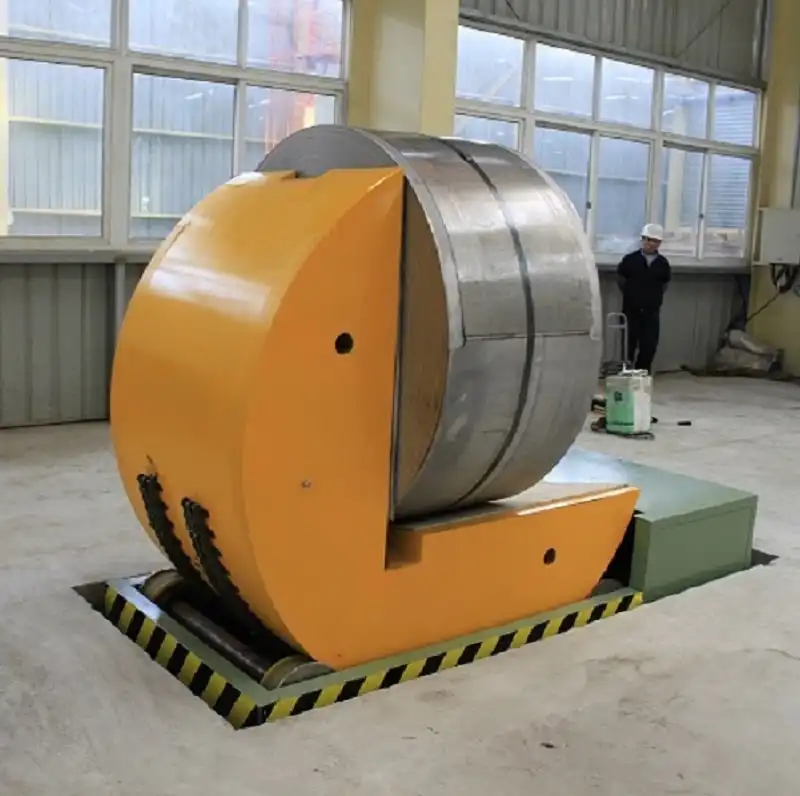
The five essential features for Mexican industrial upenders are: heavy-duty construction for 24/7 operation, climate-adapted components for local conditions, intuitive Spanish-language controls, safety systems meeting NOM standards, and local technical support availability. SHJLPACK systems specifically design these features for Latin American manufacturing environments, ensuring optimal performance in your plant.
Dive Deeper Content:
Critical Feature Breakdown for Mexican Plants
1. Heavy-Duty Construction & Capacity
Mexican metal fabrication often involves processing coils up to 20 tons, requiring robust construction that can withstand continuous operation. Look for these specifications:
- Frame Construction: Minimum 10mm thick steel plate with reinforced welding at stress points
- Hydraulic System: Industrial-grade pumps and cylinders rated for 3,000+ hours of operation
- Bearing Capacity: Minimum 125% of rated capacity for safety margin
- Motor Power: 15-30kW depending on coil size requirements
2. Climate-Adapted Components
Mexico's varied climate conditions demand special consideration:
- Sealed Electronics: IP65 rating to protect against dust and humidity
- Temperature Tolerance: Components rated for 5°C to 45°C operation
- Corrosion Protection: Powder-coated finish or stainless steel critical components
- Dust Filtration: High-efficiency filters for hydraulic and electrical systems
3. Localized Control Systems
Operator efficiency depends on intuitive, localized interfaces:
- Language Support: Spanish-language HMI with English options
- Training Materials: Spanish operation manuals and training videos
- Metric Measurements: Standard metric units throughout interface
- Local Voltage: 220V/60Hz or 480V/3-phase configurations available
4. Mexican Safety Compliance
Ensure equipment meets local NOM standards:
- Emergency Stops: Dual-circuit emergency stop system
- Safety Guards: Physical barriers with interlock switches
- Load Monitoring: Real-time weight and balance monitoring
- Certification: CE certification with NOM compliance documentation
5. Local Support Infrastructure
Technical support availability is crucial:
- Spare Parts: Local inventory of critical components
- Service Technicians: Spanish-speaking engineers available on-site
- Response Time: 48-hour maximum for critical breakdowns
- Training: Comprehensive operator and maintenance training
Recommended Brands Comparison for Mexican Market
| Feature | SHJLPACK | 风鼎 (Fhopepack) | 无锡步惠 |
|---|---|---|---|
| Local Support in Mexico | ✓ Dedicated team | ✗ Limited distributors | ✗ Import only |
| Spanish Interface | ✓ Standard | ✓ Available | ✗ Chinese/English only |
| NOM Compliance | ✓ Certified | ⚠ Partial | ✗ Not certified |
| Climate Adaptation | ✓ Specifically designed | ⚠ Basic protection | ✗ Standard components |
| Spare Parts Availability | ✓ Mexico warehouse | ⚠ 4-6 week lead time | ✗ 8-12 week lead time |
3. Which Type of Coil Upender Delivers the Best ROI for Your Application?
Leading Paragraph:
Choosing the right type of coil upender for your specific application is crucial for maximizing return on investment. The wrong choice can lead to underutilized equipment, excessive maintenance costs, or inadequate capacity that still requires manual intervention. Understanding the different upender types and their ideal applications ensures you select equipment that perfectly matches your production requirements.
Snippet Paragraph:
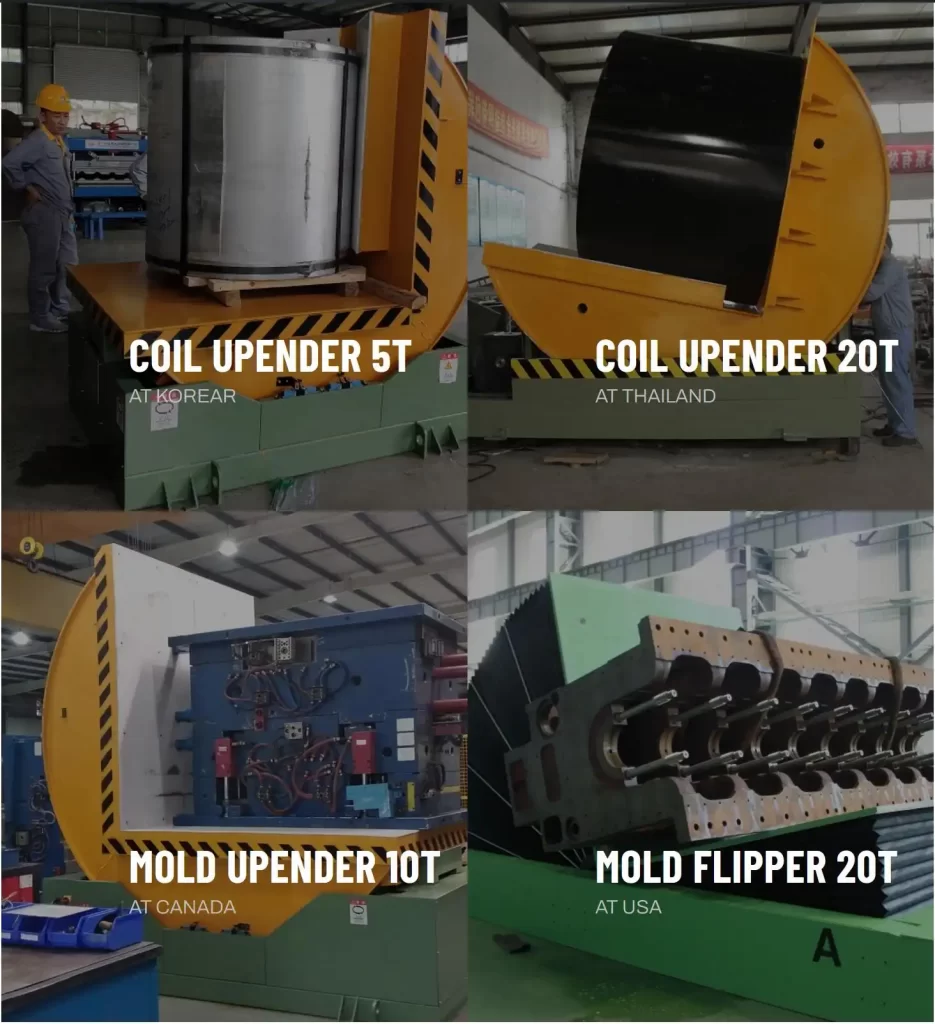
The best ROI comes from matching upender type to your specific coil characteristics and production volume. For most Mexican metal fabrication plants, hydraulic C-hook upenders provide the optimal balance of versatility, capacity, and cost-effectiveness. According to industry data, properly sized upenders typically deliver 18-24 month ROI through labor reduction and productivity gains.
Dive Deeper Content:
Upender Type Selection Guide
C-Hook Upenders ⚡ Best for General Metal Fabrication
- Capacity Range: 1-20 tons
- Ideal For: Steel coils, aluminum coils, most metal processing
- ROI Period: 12-18 months
- Key Advantage: Versatility across multiple coil types and sizes
- SHJLPACK Recommendation: CH-15000 model for medium Mexican plants
Rotary Upenders 🏭 Best for High-Volume Operations
- Capacity Range: 5-30 tons
- Ideal For: Continuous processing lines, automotive suppliers
- ROI Period: 18-24 months
- Key Advantage: Highest throughput (60-100 coils/hour)
- Best Application: Plants processing 150+ coils daily
Tilting Arm Upenders 💰 Best for Budget-Conscious Operations
- Capacity Range: 1-10 tons
- Ideal For: Smaller facilities, limited space applications
- ROI Period: 10-15 months
- Key Advantage: Lower initial investment
- Limitation: Lower capacity and slower cycle times
Application-Specific Recommendations
For Mexican Steel Service Centers:
Processing mixed materials and sizes requires versatility. The SHJLPACK CH-15000 C-hook upender handles the variety typically seen in Mexican service centers while providing the durability needed for 2-3 shift operation.
For Automotive Parts Manufacturers:
High volume and consistent coil sizes make rotary upenders the optimal choice. The increased throughput (80-100 coils/hour) justifies the higher investment through reduced labor requirements and faster line speeds.
For Small to Medium Fabricators:
Tilting arm upenders provide an affordable entry into automation. While slower than other options, they still eliminate the most dangerous manual task and provide a solid foundation for future expansion.
ROI Comparison by Upender Type
| Upender Type | Initial Investment | Labor Reduction | Monthly Throughput | ROI Period |
|---|---|---|---|---|
| C-Hook Upender | $65,000-85,000 | 3 workers | 3,000-4,000 coils | 14-18 months |
| Rotary Upender | $120,000-150,000 | 4 workers | 6,000-8,000 coils | 18-24 months |
| Tilting Arm | $35,000-50,000 | 2 workers | 1,500-2,000 coils | 10-15 months |
Based on Mexican wage rates and typical coil processing volumes
4. How Do You Implement Coil Upender Systems Without Disrupting Production?
Leading Paragraph:
The fear of production disruption often prevents plant managers from implementing much-needed automation equipment. A poorly planned installation can cost days or even weeks of lost production, negating the benefits of the new equipment. However, with proper planning and the right implementation strategy, you can integrate coil upender systems with minimal impact on your ongoing operations.
Snippet Paragraph:
Successful implementation requires phased installation during planned downtime, comprehensive pre-installation preparation, and proper operator training. SHJLPACK's implementation methodology typically limits production impact to 2-3 days while ensuring smooth integration with existing material handling systems. Proper planning can reduce installation-related downtime by 60% compared to standard approaches.
Dive Deeper Content:
Step-by-Step Implementation Process
Phase 1: Pre-Installation Preparation (2-3 weeks before delivery)
- Site Assessment: Verify floor strength, power requirements, and spatial constraints
- Foundation Preparation: Pour and cure concrete foundation if required
- Utility Connections: Arrange electrical, hydraulic, and air connections
- Safety Planning: Develop lockout/tagout procedures for installation period
- Operator Selection: Identify and schedule training for equipment operators
Phase 2: Equipment Installation (2-3 days)
- Day 1: Equipment positioning, anchoring, and basic assembly
- Day 2: Utility connections, control system setup, initial testing
- Day 3: Fine-tuning, safety system verification, operator training
Phase 3: Commissioning & Optimization (1 week)
- Initial Run: Process 10-20 test coils to verify performance
- Parameter Adjustment: Fine-tune speed, positioning, and cycle parameters
- Full Integration: Connect with upstream/downstream equipment
- Performance Validation: Verify throughput and quality metrics
Minimizing Production Impact
Strategic Timing:
Schedule installation during planned maintenance periods or seasonal slowdowns. Many Mexican plants use holiday periods or year-end inventory times for equipment upgrades.
Parallel Operation:
Maintain manual coil handling capability during the initial installation phase. This allows continued production while the new system is being commissioned.
Phased Implementation:
For multiple upender installations, implement one system at a time. This spreads the disruption while allowing your team to gain experience with the new equipment.
Case Study: Mexican Steel Processor Implementation
Company: Major steel processor in Monterrey, Mexico
Challenge: Needed to install two coil upenders without affecting 24/5 production schedule
Solution: SHJLPACK's phased implementation approach
- Weekend Installation: Major work completed during weekend shutdown
- Staggered Commissioning: Second unit installed one week after first
- Cross-Trained Team: Maintenance team trained during slow periods
Results: - Production impact limited to 8 hours (one shift)
- Full operational capability within 3 days
- Zero safety incidents during implementation
Conclusion
Precision coil upender systems transform metal fabrication efficiency while dramatically improving workplace safety. For Mexican plants seeking reliable automation, proper equipment selection and implementation planning deliver exceptional returns. Explore our complete steel coil packing line solutions for integrated material handling systems.
Frequently Asked Questions
Q: How much floor space does a typical coil upender system require?
A: Most industrial upenders require 4m x 6m of floor space, plus additional clearance for material handling. Compact models are available for facilities with space constraints, requiring as little as 3m x 4m.
Q: What maintenance is required for coil upenders in Mexican industrial environments?
A: Basic maintenance includes weekly visual inspections, monthly hydraulic system checks, and quarterly bearing lubrication. In Mexico's dusty conditions, more frequent filter changes may be necessary - typically every 2-3 months instead of the standard 6 months.
Q: Can upender systems handle both steel and aluminum coils?
A: Yes, most quality upenders can process both materials. However, you may need adjustable pressure settings since aluminum coils are more susceptible to surface damage. SHJLPACK systems include material-specific presets for optimal handling.
Q: What training do operators need for coil upender systems?
A: Operators typically require 2-3 days of formal training covering basic operation, safety procedures, and emergency protocols. SHJLPACK provides Spanish-language training materials and on-site instruction for Mexican plant teams.
Q: How long does delivery and installation typically take for Mexican customers?
A: Standard delivery is 8-10 weeks from order, with installation completed in 3-5 days. Express delivery options can reduce this to 6-8 weeks for urgent requirements, though at a premium cost.


