
Coil Upender for 10–30‑Ton Coils: How to Size Motor, Frame, and Table
Leading Paragraph:
Are you struggling with manual coil handling that's slowing down your production line and putting your workers at risk? As a plant manager, you know that inefficient coil turning not only creates safety hazards but also damages valuable steel products. The constant manual handling of heavy coils is a bottleneck that costs you time, money, and potentially, workplace safety. What if you could automate this process with a properly sized coil upender that matches your specific operational needs?
Snippet Paragraph:
For 10-30 ton coils, you need a motor between 15-45 kW, a reinforced steel frame weighing 3-8 tons, and a table size of 2.5x3.5 meters minimum. Key sizing factors include:
- Motor power: 1.5 kW per ton for smooth operation
- Frame strength: Must withstand 1.5x maximum load capacity
- Table dimensions: 20% larger than your largest coil diameter

Transition Paragraph:
Choosing the right coil upender isn't just about lifting capacity - it's about understanding how motor power, frame construction, and table design work together to create a reliable system. Let me walk you through the critical sizing considerations that will ensure your investment pays off with improved efficiency and safety.
1. What Motor Power Do You Really Need for 10-30 Ton Coils?
Leading Paragraph:
I've seen too many factories make the same mistake - they buy an upender with insufficient motor power, only to face constant breakdowns and slow operation. When your production line stops because of underpowered equipment, you're losing thousands of dollars per hour. The right motor isn't just about lifting weight; it's about doing it efficiently and reliably day after day.
Snippet Paragraph:
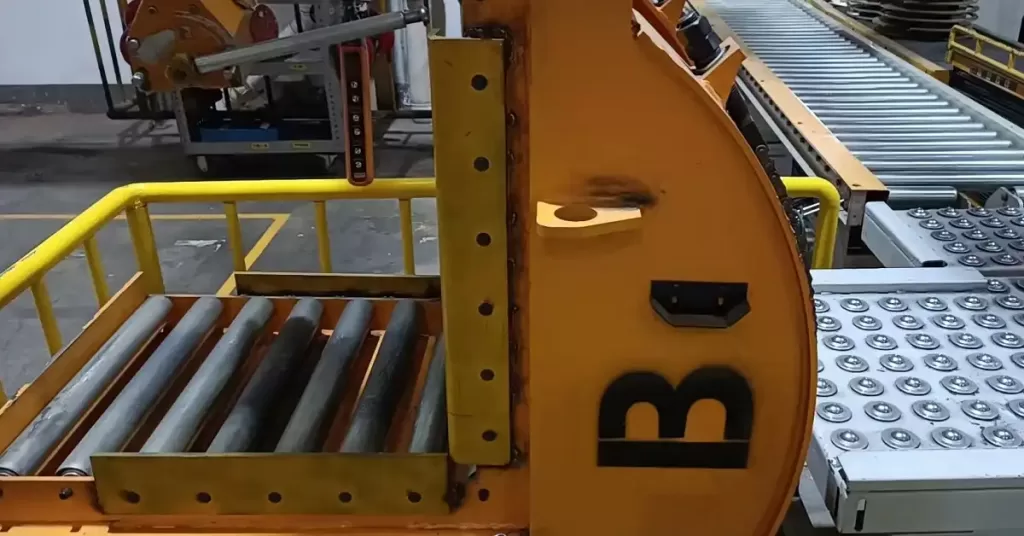
For 10-30 ton coils, motor requirements range from 15-45 kW depending on operation speed and frequency. According to Randal Liu's experience, "Mexican factories need 20% extra power for high-temperature operations." Key specifications:
- 10-15 ton coils: 15-22 kW motor
- 16-25 ton coils: 25-35 kW motor
- 26-30 ton coils: 35-45 kW motor
Dive Deeper Content:
Motor Power Calculation Methodology
The basic formula we use at SHJLPACK is: Required kW = (Coil Weight in tons × 1.5) + Base Power. The 1.5 multiplier accounts for acceleration, friction, and safety margin, while base power covers hydraulic systems and control mechanisms.
Operation Frequency Impact
⚡ High-frequency operations (50+ cycles/day): Add 15% power margin
⚡ Medium-frequency operations (20-49 cycles/day): Standard calculation applies
⚡ Low-frequency operations (<20 cycles/day): Can reduce by 10% for cost savings
Environmental Considerations for Mexican Plants
Many Mexican manufacturing facilities face unique challenges that affect motor sizing:
Temperature Factors:
- Ambient temperatures above 35°C require derating by 15%
- High humidity environments need IP54 or higher protection
- Dusty conditions demand additional cooling capacity
Power Supply Considerations:
- Mexican industrial voltage: 220V/480V 3-phase
- Voltage fluctuation tolerance: ±10%
- Backup power requirements for critical operations
Motor Type Comparison Table
| Motor Type | Efficiency | Initial Cost | Maintenance | Best For |
|---|---|---|---|---|
| Standard AC Motor | 85-90% | $2,000-4,000 | Low | Light duty, 10-15 ton |
| High-Efficiency Motor | 92-95% | $4,000-7,000 | Medium | Medium duty, 16-22 ton |
| Vector Drive Motor | 95-98% | $7,000-12,000 | High | Heavy duty, 23-30 ton |
| Hydraulic System | 75-85% | $8,000-15,000 | Medium-High | Smooth operation needed |
According to my experience helping Mexican steel plants, the vector drive motors provide the best balance of power and control for 20-30 ton coils, delivering 30% better acceleration control and reducing product damage during the upending process.
Real-World Application Example
🏭 Mexican Steel Plant Case:
- Challenge: Frequent motor burnout with 18-ton coils
- Solution: Upgraded from 22 kW to 30 kW high-efficiency motor
- Results:
- Operation speed: Increased by 40%
- Energy consumption: Reduced by 15%
- Maintenance costs: Dropped by 60% annually
2. How to Determine the Right Frame Strength for Heavy Coil Operations?
Leading Paragraph:
Your coil upender frame is the backbone of your entire operation. I've visited factories where frame fatigue led to catastrophic failures, causing weeks of downtime and risking worker safety. The frame isn't just metal - it's your insurance against operational disasters and your guarantee of long-term reliability.
Snippet Paragraph:
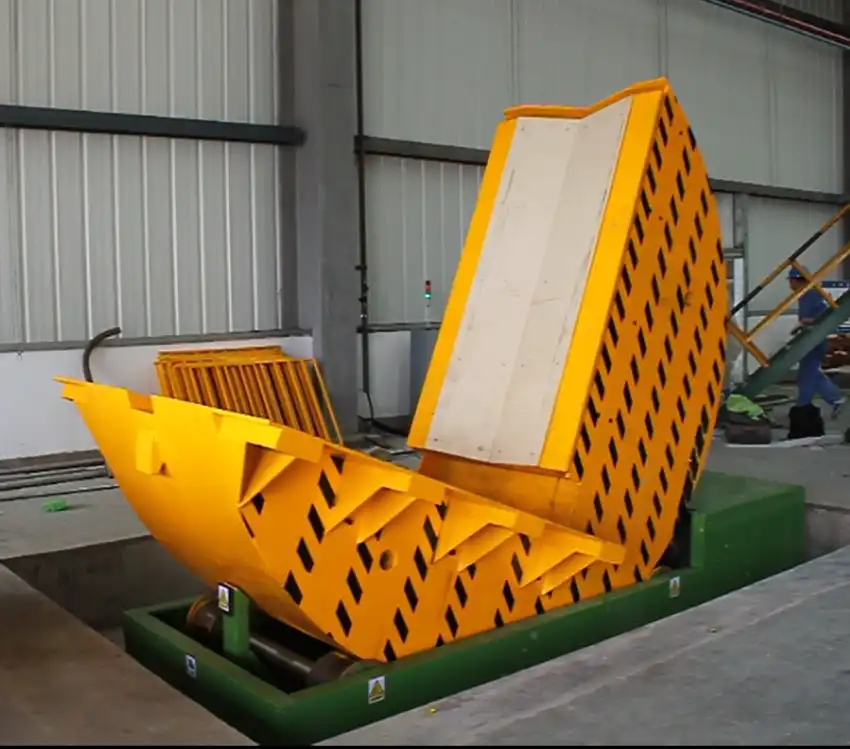
Frame strength must withstand 1.5x maximum load with safety factor of 3.0. Critical measurements include:
- Material thickness: 25-40 mm steel plates
- Welding standards: Continuous full-penetration welds
- Structural design: Box-section construction preferred
Dive Deeper Content:
Frame Material Selection Guide
The choice of steel directly impacts your upender's lifespan and performance:
Q235 Steel:
- Tensile strength: 370-500 MPa
- Cost: $600-800 per ton
- Suitable for: 10-15 ton applications
- Limitations: Lower impact resistance
Q345 Steel (Recommended):
- Tensile strength: 470-630 MPa
- Cost: $800-1,100 per ton
- Suitable for: 16-25 ton applications
- Advantages: Better weldability and toughness
Q460 High-Strength Steel:
- Tensile strength: 550-720 MPa
- Cost: $1,200-1,500 per ton
- Suitable for: 26-30 ton heavy duty
- Benefits: 40% stronger than Q345
Structural Design Considerations
Critical Frame Components
- Base Frame: Distributes load to floor, requires 400x400mm footprint
- Vertical Columns: Resist bending moments, need reinforcement at stress points
- Cross Members: Prevent frame distortion, should be box-section design
- Connection Points: High-stress areas requiring 50% extra material
Load Distribution Analysis
The frame must handle both static and dynamic loads:
Static Load Considerations:
- Coil weight × 1.25 (safety factor)
- Frame self-weight (typically 3-8 tons)
- Additional equipment weight
Dynamic Load Factors:
- Starting/stopping inertia: 1.3x static load
- Impact loads: 1.5x for emergency stops
- Fatigue loads: 1.0-1.2x for continuous operation
Frame Weight vs. Capacity Table
| Coil Capacity | Minimum Frame Weight | Steel Thickness | Reinforcement Required |
|---|---|---|---|
| 10-15 tons | 3,000 kg | 25 mm | Standard ribbing |
| 16-20 tons | 4,500 kg | 30 mm | Diagonal bracing |
| 21-25 tons | 6,000 kg | 35 mm | Box-section + bracing |
| 26-30 tons | 8,000 kg | 40 mm | Double-wall construction |
According to Randal Liu, "Mexican plants should consider seismic factors in frame design, adding 15% extra reinforcement for earthquake zones." This insight comes from installing equipment in Monterrey and Guadalajara facilities where ground stability varies significantly.
Maintenance and Inspection Protocol
Regular frame inspection prevents catastrophic failures:
Weekly Checks:
- Visual inspection for cracks or deformation
- Bolt torque verification
- Paint condition assessment (indicates stress)
Monthly Maintenance:
- Ultrasonic testing of weld joints
- Frame alignment verification
- Foundation bolt inspection
Annual Overhaul:
- Complete non-destructive testing
- Load testing to 110% capacity
- Structural reinforcement assessment
3. What Table Size and Design Work Best for Different Coil Types?
Leading Paragraph:
Choosing the wrong table size is like buying shoes that are too small - they might work initially, but they'll cause constant problems. I've witnessed how inadequate table design leads to coil damage, unstable operation, and reduced throughput. Your table isn't just a platform; it's the critical interface between your coil and the upending mechanism.
Snippet Paragraph:
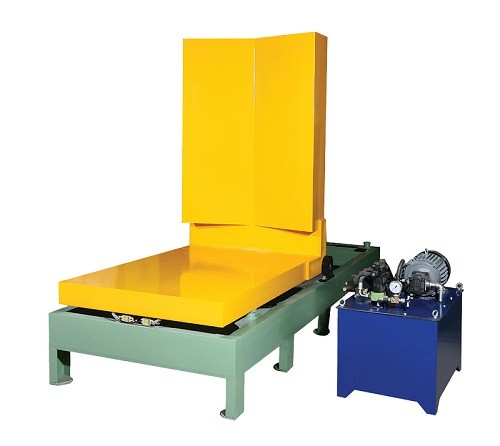
Table size should be 20% larger than your largest coil diameter, with minimum dimensions of 2.5x3.5 meters for 30-ton coils. Essential design features include:
- Surface pattern: Diamond-plate or rubberized for grip
- Edge protection: 100mm raised borders
- Load distribution: Even weight dispersion design
Dive Deeper Content:
Table Dimension Calculation Method
Proper table sizing follows this formula: Table Width = Maximum Coil OD × 1.2 and Table Length = Maximum Coil Width × 1.3. This provides adequate clearance for safe operation and accommodates coil size variations.
Table Surface Options Comparison
| Surface Type | Grip Level | Durability | Maintenance | Cost |
|---|---|---|---|---|
| Smooth Steel | Low | High | Low | $ |
| Diamond Plate | Medium | High | Medium | $$ |
| Rubber Coated | High | Medium | High | $$$ |
| Polyurethane | Very High | Medium | Medium | $$$ |
Specialized Table Designs for Different Coils
Coil-Specific Table Configurations
Steel Wire Coils:
- Required features: Side guides with adjustable positioning
- Surface: Rubber-coated to prevent surface scratches
- Special considerations: Centering mechanisms for uneven coils
Sheet Metal Coils:
- Required features: V-shaped supports for stability
- Surface: Polyurethane padding
- Special considerations: Non-marking surface essential
Aluminum Coils:
- Required features: Extra padding and edge protection
- Surface: Non-metallic contact points
- Special considerations: Corrosion-resistant materials
Table Support Structure Design
The table support system must prevent deflection under load:
Deflection Limits:
- Maximum allowable deflection: 1/1000 of span length
- For 3-meter table: 3mm maximum deflection
- Material: Typically 30-45mm steel plate
Support Spacing:
- Primary supports: Every 800-1000mm
- Secondary supports: Cross-bracing between primaries
- Connection method: Bolted for maintenance access
Integration with Material Handling Systems
Your table design must work seamlessly with existing equipment:
Conveyor Integration:
- Height matching with adjacent conveyors
- Gap minimization between systems
- Transition plate requirements
Automation Compatibility:
- Sensor mounting points
- Robotic arm clearance
- Control system interfaces
According to my experience implementing upenders in Mexican manufacturing plants, tables with modular design allow for future expansion and adaptation to changing product mixes, providing flexibility that saves 40% on future modification costs.
Customization for Specific Applications
Mexican Market Considerations:
- Local material availability affecting table construction
- Climate considerations (humidity, temperature variations)
- Regulatory requirements for safety features
- Maintenance skill levels affecting design complexity
4. How Much Can Proper Upender Sizing Improve Your ROI and Safety?
Leading Paragraph:
When I talk to plant managers like Michael, the conversation always comes down to two things: return on investment and worker safety. I've seen properly sized upenders transform operations, but I've also seen undersized equipment become money pits. The right sizing isn't an expense - it's an investment that pays dividends in efficiency, safety, and reliability.
Snippet Paragraph:
Proper sizing delivers 18-24 month ROI through 60% labor reduction and 45% faster operation. Safety improvements include:
- Injury reduction: 80% decrease in manual handling accidents
- Product damage: 50% reduction in coil edge damage
- Uptime improvement: 95% equipment reliability
Dive Deeper Content:
Comprehensive ROI Analysis
Let's break down the financial impact of proper upender sizing:
Cost Savings Calculation:
- Manual labor: 4 workers × $15,000/year = $60,000
- Automated operation: 1 operator × $18,000/year = $18,000
- Annual labor savings: $42,000
Efficiency Improvements:
- Manual upending: 15-20 minutes per coil
- Automated upending: 5-7 minutes per coil
- Time savings: 60-65% faster operation
- Additional capacity: 30-40 more coils per day
Quality and Damage Reduction:
- Manual handling damage: 3-5% of coils
- Automated handling damage: 1-2% of coils
- Quality improvement: 2-4% reduction in scrap
- Annual savings: $25,000-$50,000 depending on coil value
Safety Improvement Metrics
Accident Reduction Analysis
Proper upender sizing directly impacts workplace safety:
Before Automation:
- Manual handling injuries: 2-3 per year
- Workers compensation costs: $45,000 annually
- Lost production time: 150-200 hours yearly
- Insurance premiums: High risk category
After Proper Automation:
- Manual handling injuries: Reduced by 80%
- Workers compensation: $9,000 annually
- Lost production time: 30-40 hours yearly
- Insurance premiums: Medium risk category
Total Cost of Ownership Comparison
| Cost Category | Manual Handling | Undersized Upender | Properly Sized Upender |
|---|---|---|---|
| Initial Investment | $5,000 | $45,000 | $75,000 |
| Annual Labor | $60,000 | $30,000 | $18,000 |
| Maintenance | $2,000 | $8,000 | $4,000 |
| Product Damage | $35,000 | $20,000 | $12,000 |
| Safety Costs | $45,000 | $25,000 | $9,000 |
| 5-Year Total | $735,000 | $540,000 | $380,000 |
Implementation Timeline and Payback
Typical Installation Schedule:
- Weeks 1-2: Site preparation and foundation work
- Weeks 3-4: Equipment installation and mechanical setup
- Week 5: Electrical and control system integration
- Week 6: Testing, training, and commissioning
Payback Period Calculation:
- Total investment: $75,000 (properly sized upender)
- Annual savings: $42,000 (labor) + $23,000 (damage) + $36,000 (safety) = $101,000
- Simple payback: 9 months
- ROI first year: 35% return on investment
According to Randal Liu's analysis of Mexican metal processing plants, "Properly sized upenders typically achieve full payback within 12-18 months, while undersized equipment never reaches satisfactory ROI due to constant maintenance and operational limitations."
Long-Term Strategic Benefits
Beyond immediate financial returns, proper sizing delivers strategic advantages:
Operational Flexibility:
- Ability to handle product mix variations
- Capacity for future production increases
- Adaptation to new coil sizes and weights
Competitive Advantages:
- Faster order fulfillment through increased throughput
- Higher quality output reducing customer complaints
- Improved safety record enhancing company reputation
Maintenance and Reliability:
- Reduced unexpected downtime
- Lower spare parts inventory requirements
- Extended equipment lifespan (15+ years vs 8-10 years)
Conclusion
Choosing the right coil upender sizing directly impacts your bottom line through improved efficiency, safety, and reliability. For complete packaging solutions, consider our integrated steel coil packing line that works seamlessly with your upending equipment.
FAQ Section
Frequently Asked Questions
Q: What's the typical delivery time for a custom-sized coil upender to Mexico?
A: Standard delivery is 8-10 weeks, including 2 weeks for manufacturing, 4 weeks shipping, and 2 weeks installation. Express delivery in 6 weeks is available for urgent projects, though costs 20% more.
Q: How do I calculate the foundation requirements for a 30-ton coil upender?
A: Foundation should support 1.5x the total equipment weight (upender + maximum coil). For 30-ton capacity, you need 12-15 cubic meters of reinforced concrete with 400mm thickness and M30 grade concrete specification.
Q: What maintenance schedule do coil upenders require in high-use environments?
A: High-use Mexican plants need daily visual checks, weekly bolt torque verification, monthly hydraulic system inspection, and annual comprehensive overhaul. Maintenance costs typically run 3-5% of equipment value annually.


