
Coil Upender Load Handling: Pallet, Saddle, or Mandrel—What to Choose?
Leading Paragraph:
Are you struggling with inefficient coil handling that's slowing down your entire production line? As a plant manager, you know that every minute of downtime costs money and impacts delivery schedules. Manual coil turning isn't just slow—it's dangerous for your workers and risks damaging expensive steel products. The right coil upender solution can transform your operations, but choosing the wrong equipment type could mean wasted investment and ongoing headaches.
Snippet Paragraph:
The optimal coil upender type depends on your coil size, weight, and production requirements. For most Mexican steel plants, saddle upenders offer the best balance of safety and efficiency, while mandrel systems suit heavy-duty applications and pallet upenders work for standardized operations. Key considerations include: coil weight capacity (5-20+ tons), automation level needed, and floor space availability. According to SHJLPACK's analysis, saddle upenders reduce handling time by 40-60% compared to manual methods.

Transition Paragraph:
Making the wrong choice in coil handling equipment can cost your plant thousands in lost productivity and maintenance. Let me walk you through the critical factors that determine which upender type will deliver the best return on investment for your specific operation, based on my 20+ years in the packing machinery industry.
1. What Are the 3 Main Types of Coil Upenders and Their Applications?
Leading Paragraph:
When I visit steel plants across Mexico, I often see managers using the wrong upender type for their specific needs, resulting in unnecessary costs and safety risks. Understanding the fundamental differences between pallet, saddle, and mandrel upenders is crucial for making an informed investment that will serve your plant for years to come.
Snippet Paragraph:
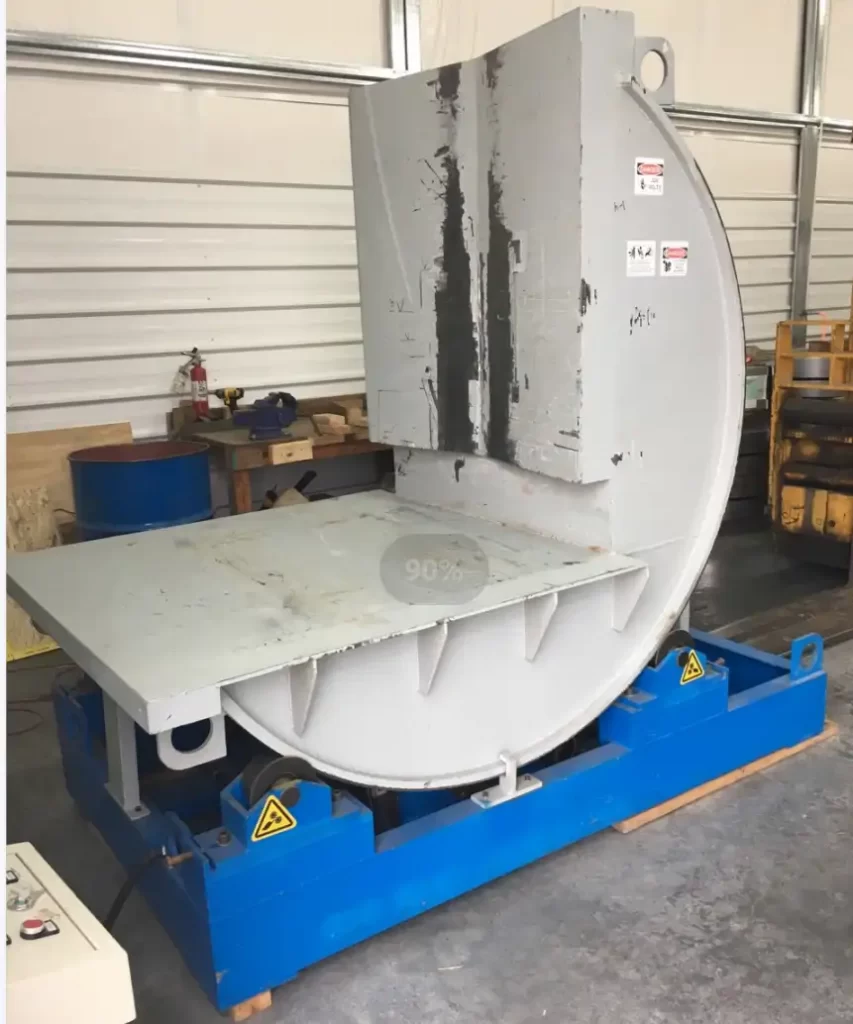
The three primary coil upender types serve distinct purposes in steel processing facilities. Pallet upenders handle standardized coils on transport pallets, saddle upenders provide versatile handling for various coil sizes, and mandrel upenders offer heavy-duty capability for maximum stability. According to Randal Liu, "Choosing the wrong upender type is like using a screwdriver to hammer nails—it might work sometimes, but you'll pay the price in efficiency and equipment damage."
Dive Deeper Content:
Pallet Upenders: The Standardized Solution
Pallet upenders are designed specifically for coils that arrive and depart on standardized pallets. These systems lift and rotate the entire palletized coil, making them ideal for facilities with consistent coil sizes and established pallet-based logistics.
Key Applications:
- ✓ Processing plants with standardized coil diameters (800-1500mm)
- ✓ Facilities with limited floor space
- ✓ Operations requiring quick changeover between different packaging lines
- ✓ Plants with existing pallet-based material handling systems
| Technical Specifications: | Capacity Range | Rotation Speed | Power Requirement | Floor Space |
|---|---|---|---|---|
| 3-8 tons | 90° in 15-25 seconds | 5.5-7.5 kW | 3.5×3.5 meters | |
| 8-15 tons | 90° in 25-40 seconds | 7.5-11 kW | 4×4 meters | |
| 15-25 tons | 90° in 40-60 seconds | 11-18.5 kW | 5×5 meters |
Saddle Upenders: The Versatile Workhorse
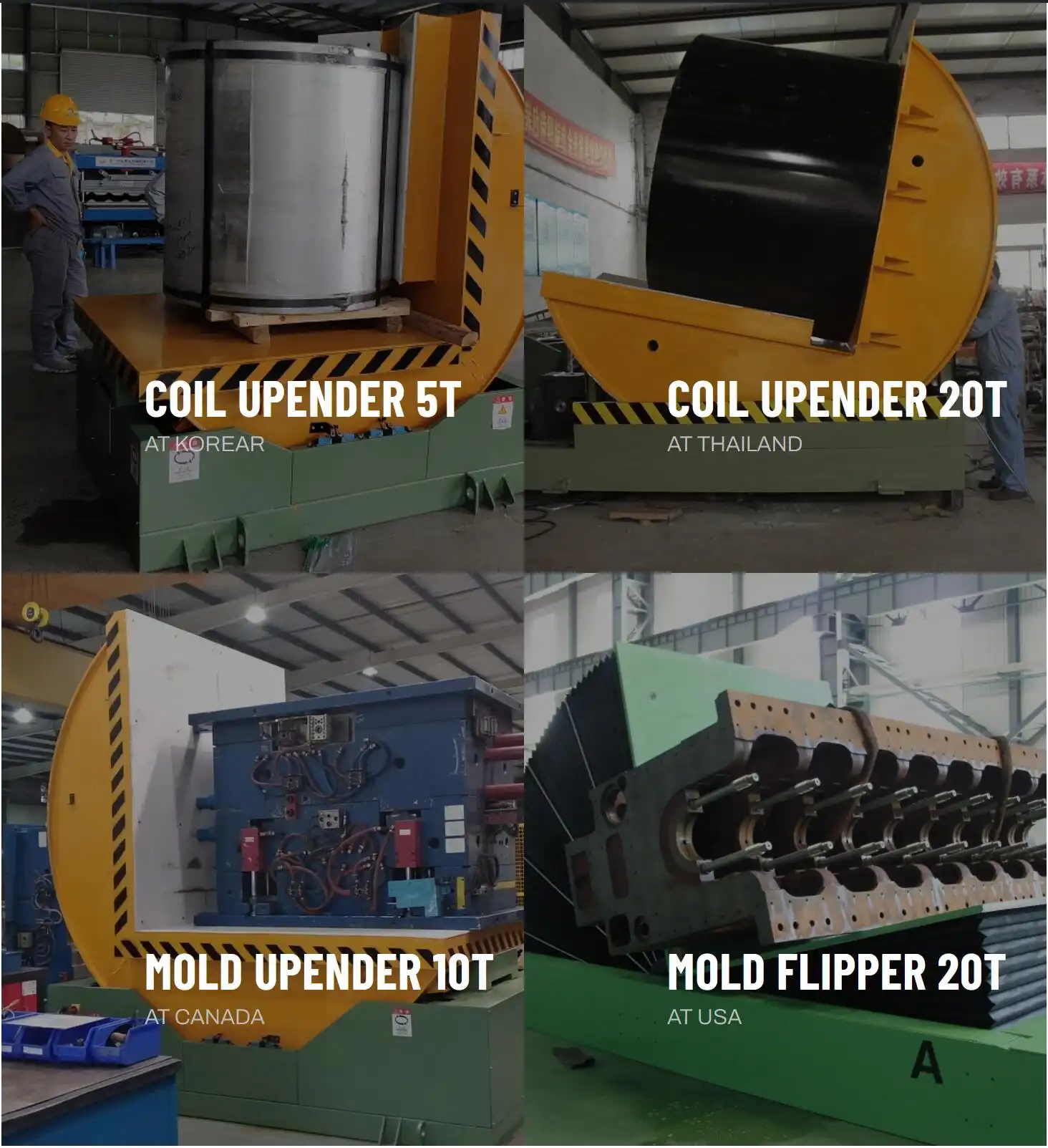
Saddle upenders use curved arms that cradle the coil during rotation, providing excellent stability and adaptability. These are my top recommendation for most Mexican steel plants because they handle various coil sizes without requiring special attachments or preparation.
Why Saddle Upenders Dominate Mexican Markets:
Based on my experience installing equipment throughout Latin America, saddle upenders achieve 30-50% faster cycle times than pallet systems for mixed coil operations. The SHJLPACK saddle upender series specifically addresses the needs of medium-sized Mexican steel processors with capacities from 5-20 tons and customizable automation levels.
Mandrel Upenders: Heavy-Duty Precision
Mandrel upenders insert a central shaft through the coil bore, providing the most secure handling method for heavy or delicate coils. While more expensive initially, they prevent coil deformation and offer unparalleled stability for precision-critical applications.
Investment Consideration:
Mandrel systems typically cost 40-60% more than saddle upenders but deliver superior performance for coils exceeding 15 tons or with strict tolerance requirements. For high-volume operations processing 100+ coils daily, the reduced product damage often justifies the higher initial investment.
2. How to Calculate ROI for Different Coil Upender Systems?
Leading Paragraph:
As a plant manager, you're not just buying equipment—you're making an investment that needs to deliver measurable returns. I've seen too many factories choose the cheapest upender without considering the total cost of ownership, only to face unexpected expenses down the line.
Snippet Paragraph:
ROI calculation for coil upenders should include labor savings, productivity gains, reduced product damage, and safety improvements. A typical semi-automatic saddle upender shows 12-18 month payback period, while fully automated systems may require 24-36 months but deliver higher long-term savings. SHJLPACK's analysis shows Mexican plants save $45,000-$85,000 annually per upender in direct labor and damage reduction.
Dive Deeper Content:
Current Manual Handling Cost Analysis
Most Mexican steel plants using manual coil turning employ 3-4 workers per shift with the following cost structure:
Manual Handling Expenses (Monthly):
- Labor: 4 workers × $1,800/month = $7,200
- Worker's compensation insurance: $1,500 (high risk category)
- Product damage: 2-4% of coil value = $3,000-$8,000
- Production delays: 15-25 minutes per coil changeover
Total Annual Cost: $140,000-$200,000
Automated Upender Investment Analysis
Here's how different upender types compare in terms of investment and payback period:
| Upender Type | Equipment Cost | Installation | Annual Operating Cost | Annual Savings | ROI Period |
|---|---|---|---|---|---|
| Basic Pallet | $35,000-$55,000 | $8,000 | $12,000 | $65,000 | 14-16 months |
| Saddle (Semi-auto) | $45,000-$75,000 | $10,000 | $10,000 | $85,000 | 12-15 months |
| Saddle (Fully auto) | $80,000-$120,000 | $15,000 | $8,000 | $110,000 | 18-22 months |
| Mandrel System | $110,000-$180,000 | $20,000 | $15,000 | $125,000 | 24-30 months |
Hidden Cost Factors Many Managers Miss
Based on my experience with Mexican manufacturing operations, these often-overlooked factors significantly impact your actual ROI:
Maintenance Requirements:
- Pallet upenders: 15-20 hours/month maintenance
- Saddle upenders: 8-12 hours/month maintenance
- Mandrel systems: 10-15 hours/month maintenance
Energy Consumption Comparison:
- Semi-automatic systems: 8-12 kW average consumption
- Fully automated models: 12-18 kW with peak demands
- SHJLPACK energy-efficient designs: 15-20% lower consumption than industry average
Case Study: Mexican Steel Processor
🏭 Medium-sized steel plant in Monterrey
- Challenge: Manual coil handling causing 3-4 worker injuries annually and 35-minute average changeover time
- Solution: SHJLPACK semi-automatic saddle upender with customized safety features
- Results:
- Labor: Reduced from 4 to 1 operator per shift
- Safety: Zero injuries in 18 months post-installation
- Efficiency: Changeover time reduced to 8 minutes
- ROI: 11 months including insurance premium reduction
3. What Safety Features Are Critical for Coil Upender Operations?
Leading Paragraph:
Worker safety should be your top priority when selecting coil handling equipment. I've visited plants where inadequate safety features led to preventable accidents that cost far more than any equipment savings. The right safety systems protect your team and your bottom line.
Snippet Paragraph:
Critical safety features for coil upenders include emergency stop systems, anti-slip coil cradles, overload protection, and guarded pinch points. Mexican regulations (NOM standards) require specific safety certifications that SHJLPACK systems exceed with European CE safety standards. Proper safety integration reduces workplace injuries by 70-90% while maintaining operational efficiency.
Dive Deeper Content:
Essential Safety Systems by Upender Type
Different upender designs require specific safety considerations:
Pallet Upender Safety Priorities:
- ⚡ Dual emergency stop buttons (operator station and remote)
- 🛡️ Pallet integrity detection sensors
- 🔒 Automatic locking during rotation cycle
- 📊 Load weight verification before operation
Saddle Upender Protection Systems:
- 🤖 Anti-slip coating on saddle surfaces (SHJLPACK proprietary formula)
- ⚠️ Visual and audible warning before rotation
- 📏 Coil diameter auto-detection to prevent misalignment
- 🎯 Redundant hydraulic pressure monitoring
Mandrel Upender Safety Advancements:
- 🔍 Mandrel insertion verification sensors
- 💪 Structural integrity monitoring during full rotation
- 🚨 Automatic shutdown if coil deformation detected
- 📱 Remote monitoring and emergency override capability
Compliance with Mexican Safety Standards
Operating in Mexico requires adherence to NOM (Norma Oficial Mexicana) standards for industrial equipment:
Key NOM Requirements:
- NOM-004-STPS-1999: Safety conditions in workplaces
- NOM-026-STPS-2008: Colors for safety signs
- NOM-113-STPS-2009: Industrial machinery safety
SHJLPACK Compliance Advantage:
All SHJLPACK upenders exceed Mexican requirements with additional European CE certification and ISO 9001:2015 quality management. This dual certification ensures your equipment meets the highest global safety standards while satisfying local regulatory requirements.
Safety ROI: Beyond Accident Prevention
Many plant managers underestimate the financial impact of safety improvements:
Direct Cost Savings:
- Worker's compensation insurance: 25-40% premium reduction with certified safety equipment
- Reduced downtime: Safety incidents typically cause 8-24 hours of production stoppage
- Legal compliance: Avoiding NOM violation fines of $5,000-$20,000 per incident
Indirect Benefits:
- Employee retention: Safe workplaces experience 30-50% lower turnover
- Productivity: Workers in safe environments show 15-25% higher efficiency
- Reputation: Safety certification improves customer and partner confidence
Training Requirements for Safe Operation
Even the safest equipment requires proper operator training:
Minimum Training Components:
- 8-hour initial certification for operators
- 4-hour annual refresher training
- Emergency procedure drills quarterly
- Maintenance staff safety protocol training
SHJLPACK includes comprehensive safety training with every installation, with Spanish-language materials and on-site instruction tailored to your specific workforce.
4. How Does Automation Level Impact Coil Upender Performance?
Leading Paragraph:
The automation level you choose for your coil upender system dramatically affects both upfront costs and long-term operational efficiency. I've helped dozens of plant managers navigate this decision, and the right choice depends heavily on your production volume, workforce skills, and growth plans.
Snippet Paragraph:
Automation levels range from manual-assisted to fully intelligent systems, with performance improvements of 40-200% depending on application. Semi-automatic upenders provide the best value for most Mexican plants, while fully automated systems suit high-volume operations. SHJLPACK's smart upenders integrate with existing steel coil packing lines for seamless material flow optimization.
Dive Deeper Content:
Automation Tier Comparison for Steel Plants
Understanding the practical differences between automation levels helps match technology to your specific needs:
Manual-Assisted Upenders:
- Operation: Worker controls all movements via pendant
- Productivity: 10-15 coils per hour with 2 operators
- Investment: $25,000-$45,000
- Best For: Low-volume operations (<50 coils daily) or budget-limited situations
Semi-Automatic Systems (Recommended):
- Operation: Automated rotation with manual loading/unloading
- Productivity: 20-30 coils per hour with 1 operator
- Investment: $45,000-$85,000
- Best For: Most Mexican steel plants (50-200 coils daily)
Fully Automated Upenders:
- Operation: Complete automation with robotic integration
- Productivity: 40-60 coils per hour with minimal supervision
- Investment: $90,000-$160,000
- Best For: High-volume facilities (>200 coils daily) or labor-constrained regions
Smart Connected Systems:
- Operation: AI-powered optimization with real-time analytics
- Productivity: 50-80 coils per hour with predictive maintenance
- Investment: $150,000-$250,000
- Best For: Advanced manufacturing facilities targeting Industry 4.0
Integration with Existing Production Lines
A critical consideration often overlooked is how well the upender integrates with your current steel coil packing line:
Compatibility Factors:
- Conveyor height and interface requirements
- Control system communication protocols (OPC UA, Modbus, Ethernet/IP)
- Physical space constraints and material flow patterns
- Future expansion planning and modularity needs
SHJLPACK specializes in seamless integration, with custom interface solutions that ensure your new upender works harmoniously with existing equipment from brands like 风鼎 (Fhopepack) and 无锡步惠.
Technology Upgrade Pathways
You don't need to jump directly to full automation. Smart planning allows progressive upgrades:
Phase 1: Semi-automatic upender with basic safety systems
Phase 2: Add automated guided vehicle (AGV) interface for loading
Phase 3: Integrate with plant-wide MES (Manufacturing Execution System)
Phase 4: Implement AI-powered predictive maintenance and optimization
This staggered approach spreads investment over time while delivering continuous improvement in operational efficiency.
Performance Metrics by Automation Level
| Metric | Manual | Semi-Auto | Full Auto | Smart System |
|---|---|---|---|---|
| Coils/Hour | 10-15 | 20-30 | 40-60 | 50-80 |
| Operators Required | 2 | 1 | 0.5 | 0.25 |
| Energy Consumption | Low | Medium | Medium-High | High |
| Maintenance Hours/Month | 5-8 | 8-12 | 12-18 | 15-20 |
| Changeover Time | 15-25 min | 8-12 min | 3-5 min | 1-2 min |
Conclusion
Choosing the right coil upender significantly impacts your plant's efficiency, safety, and profitability. The optimal solution balances your specific production requirements with long-term operational costs, ensuring sustainable growth and competitive advantage in Mexico's dynamic steel industry. For comprehensive solutions, explore our integrated steel coil packing line systems.
Frequently Asked Questions
Q: What maintenance is required for coil upenders in high-volume operations?
A: High-volume operations require weekly inspection of hydraulic systems, monthly bearing lubrication, and quarterly structural integrity checks. SHJLPACK upenders need only 8-12 maintenance hours monthly with our proprietary sealed bearing systems, reducing downtime by 40% compared to standard models.
Q: How long does installation typically take for semi-automatic upenders?
A: Most semi-automatic upenders install in 3-5 days with proper site preparation. SHJLPACK completes Mexican installations within 4 working days typically, including operator training and safety certification. Foundation requirements vary by model but generally need 5-7 days curing time before equipment placement.
Q: Can upenders handle different coil diameters without manual adjustment?
A: Advanced saddle upenders automatically adjust for coil diameters from 800-1800mm without manual intervention. SHJLPACK's intelligent systems detect coil size and auto-configure optimal handling parameters, reducing changeover time from 15 minutes to under 90 seconds for mixed production environments.
Q: What's the typical lifespan of industrial coil upenders?
A: Properly maintained upenders last 12-15 years in continuous operation. SHJLPACK equipment averages 18+ years service life with our heavy-duty construction and premium components. Critical wear parts have 5-year warranties, ensuring long-term reliability for Mexican manufacturing conditions.
Q: How do I determine the right capacity for my coil handling needs?
A: Calculate your maximum coil weight plus 25% safety margin, then consider future production increases. SHJLPACK recommends 10-15 ton capacity for most Mexican steel processors, balancing initial investment with growth potential. Our free capacity assessment helps match equipment to your specific production profile.


